AYAT IN MAN’S INTUITION, CONSCIOUSNESS AND MORAL CONCEPTIONS
A
وَقَالَ ٱلَّذِينَ لَا يَعۡلَمُونَ لَوۡلَا يُكَلِّمُنَا ٱللَّهُ أَوۡ تَأۡتِينَآ ءَايَةٞۗ كَذَٰلِكَ قَالَ ٱلَّذِينَ مِن قَبۡلِهِم مِّثۡلَ قَوۡلِهِمۡۘ تَشَٰبَهَتۡ قُلُوبُهُمۡۗ قَدۡ بَيَّنَّا ٱلۡأٓيَٰتِ لِقَوۡمٖ يُوقِنُونَ ١١٨ [البقرة:118-118]
And those who have knowledge say: ‘Why does not Allah speak to us (face to face) or why does not a sign come to us?’ So said the people before them words of similar import. Their hearts are alike, We have indeed made plain the signs for people who believe with certainty.
Surah 2 Al-Baqarah Verse 118
- The fact is that the misguided people of the time of the revelation of the Quran did not raise any objection or make any demands essentially different from those of the misguided people of the past. From the remote past till today, error and misguidance seem to have the same character, so the same doubts and objections are repeated over and over again.
- The demand that Allah should speak to them directly was too absurd even to be answered. It is only pointed out that many signs do exist, but all such signs are of profit only to those who are inclined to believe.
إِنَّ ٱلَّذِينَ يَكۡتُمُونَ مَآ أَنزَلۡنَا مِنَ ٱلۡبَيِّنَٰتِ وَٱلۡهُدَىٰ مِنۢ بَعۡدِ مَا بَيَّنَّٰهُ لِلنَّاسِ فِي ٱلۡكِتَٰبِ أُوْلَٰٓئِكَ يَلۡعَنُهُمُ ٱللَّهُ وَيَلۡعَنُهُمُ ٱللَّٰعِنُونَ ١٥٩ [البقرة:159-159]
Verily, those who conceal the clear proofs, evidences and the guidance, which We have sent down, after We have made it clear for the people in the Book, they are like the ones cursed by Allah and cursed by the cursers.
Surah 2 Al-Baqarah Verse 159
- The biggest failures of the Jews were that they kept the teachings contained in the Book of Allah confined to a limited class of people, the Rabbis and professional theologians, instead of spreading them. They did not allow this knowledge to filter through even to the Jewish masses let alone the non-Jewish people of the world. Later, when errors and corruption spread among them owing to widespread ignorance the Jewish theologians made no serious efforts to root them out. Moreover, in order to maintain their hold on the Jewish masses they lent their tacit approval to every corrupting deviation from the true faith that gained currency. The Muslims are being admonished to refrain from this kind of behavior.
- Narrated Abu Hurairah, that the Prophet (pbuh) said: ‘Whoever was asked about knowledge that one has, but he hid it, then a bridle made of fire will be tied around his mouth on the Day of Judgment’
- It is also recorded by Al-Bukhari that Abu Hurairah said, “If it was not for an Ayah in Allah’s Book, I would not have narrated a Hadith for anyone” (referring to this Ayah)
أَيَوَدُّ أَحَدُكُمۡ أَن تَكُونَ لَهُۥ جَنَّةٞ مِّن نَّخِيلٖ وَأَعۡنَابٖ تَجۡرِي مِن تَحۡتِهَا ٱلۡأَنۡهَٰرُ لَهُۥ فِيهَا مِن كُلِّ ٱلثَّمَرَٰتِ وَأَصَابَهُ ٱلۡكِبَرُ وَلَهُۥ ذُرِّيَّةٞ ضُعَفَآءُ فَأَصَابَهَآ إِعۡصَارٞ فِيهِ نَارٞ فَٱحۡتَرَقَتۡۗ كَذَٰلِكَ يُبَيِّنُ ٱللَّهُ لَكُمُ ٱلۡأٓيَٰتِ لَعَلَّكُمۡ تَتَفَكَّرُونَ ٢٦٦ [البقرة:266-266]
Would any of you wish to have a garden with date palms and vines, with rivers flowing underneath, and all kinds of fruits for him therein, while he is stricken with old age, and his children are weak, then he is struck with a fiery whirlwind, so that it is burnt? Thus does Allah make clear His Ayat to you that you may give thought.
Surah 2 Al-Baqarah Verse 266
- Al- Bukhari recorded that Ibn Abbas and Ubayd bin Umayr said that Umar bin Al-Khattab asked the companions, “According to your opinion, about whom was this Ayah (V 2:266) revealed?” They said, “Allah knows best”. Umar became angry and said, “Say we know or we do not know”. Ibn Abbas said, “O leader of the faithful! I have an opinion about it”. Umar said. “O my nephew! Say your opinion and do not belittle yourself”. Ibn Abbas said, “This is an example set for a deed”. Umar said “What type of deed?”, Ibn Abbas said, “For a wealthy man who works in Allah’s pleasure and then Allah sends Shaytan to him, and he works in disobedience, until he annuls his good works”. The Ayah thus sets example of a person who does good first and then follows it with evil. When he desperately needed the deeds (good ones), there was none.
- The parable is of an old man whose offspring and children are weak just before the end of his life. Then a lightning storm came and destroyed his garden. Then he did not have the strength to grow another garden, nor did his offspring could offer enough help. This is the condition of the disbeliever on the Day of Resurrection when he returns to Allah, for he will not have any good deeds to provide an excuse - or refuge - for him, just as the man in the parable had no strength to replant the garden. The disbeliever will not find anything to resort to for help, just as the offspring of the man in the parable did not provide him with help. So he will be deprived of his reward when he most needs it, just as the man in the parable was deprived of Allah’s garden when he most needed it, when he became old and his offspring weak.
- In his Mustadrak, Al-Hakim recorded that the Prophet (pbuh) used to say in his supplication: ‘O Allah! Make your biggest provision for me when I am old in age and at the time my life ends’.
كَدَأۡبِ ءَالِ فِرۡعَوۡنَ وَٱلَّذِينَ مِن قَبۡلِهِمۡۚ كَذَّبُواْ بَِٔايَٰتِنَا فَأَخَذَهُمُ ٱللَّهُ بِذُنُوبِهِمۡۗ وَٱللَّهُ شَدِيدُ ٱلۡعِقَابِ ١١ [آل عمران:11-11]
Like the behavior of the people of Firaun (Pharaoh) and those before them; they denied Our Ayat. So Allah seized (destroyed) them for their sins. And Allah is Severe in punishment.
Surah 3 Al-Imran Verse 11
- Read in conjunction with the previous verse (V 3:10) this Ayah indicates that the disbelievers will not benefit from their wealth or offspring. Rather, they will perish and be punished. This is the same end the people of Firaun and the previous nations met - those who rejected the Messengers, the Ayat, and proofs of Allah that they were sent with.
يَٰٓأَهۡلَ ٱلۡكِتَٰبِ لِمَ تَكۡفُرُونَ بَِٔايَٰتِ ٱللَّهِ وَأَنتُمۡ تَشۡهَدُونَ ٧٠ يَٰٓأَهۡلَ ٱلۡكِتَٰبِ لِمَ تَلۡبِسُونَ ٱلۡحَقَّ بِٱلۡبَٰطِلِ وَتَكۡتُمُونَ ٱلۡحَقَّ وَأَنتُمۡ تَعۡلَمُونَ ٧١ [آل عمران:70-71]
‘O people of the Scripture (Jews and Christians)! Why do you disbelieve in the Ayat of Allah while you (yourselves) bear witness (to the truth)? O people of the Scripture: Why do you mix truth with falsehood and conceal the truth while you know?’
Surah 3 Al-Imran Verses 70-71
- There exists in the Taurat (Torah) and the Injil (Gospel), even after the original text has been distorted, clear prophesies indicating the coming of Prophet Muhammad (pbuh). Let us see a few of them:
Prophet Muhammad in the Old Testament
- A Prophet from among the brothers of the Israelites who resembles Moses - the following verses of the Torah promise the coming of the Prophet Muhammad, upon him be peace and blessings:
The Lord said to me [Moses]: ‘What they say is good. I will raise up for them a Prophet like you among their brothers; I will put My words in his mouth, and he will tell them everything I command him. If anyone does not listen to My words that the Prophet speaks in My Name, I will Myself call him to account. (Deuteronomy, 18.17-9)
It is clear from these verses that what is meant by ‘a Prophet like you among their brothers’ is a Prophet who will come from the line of Ishmael, since Ishmael is the brother of Isaac, who is the forefather of Moses’ people, the Children of Israel. The only Prophet who came from the line of Ishmael after Moses and resembled him in many ways, for example, in the bringing of a new law and waging of war on his enemies, is the Prophet Muhammad, pbuh. Also, the following verse of the Bible in Deuteronomy, 34.12 (Istanbul 1885), clearly states that no Prophet like Moses did ever appear among the Israelites:
With respect to his virtues and awesome deeds, no Prophet like Moses, whom the Lord knows face to face, no longer appeared among Israel.
The Quran points to the same fact:
We have sent to you a Messenger as a witness over you, even as We sent to Pharaoh a Messenger. (Al-Muzammil 73:15)
The sentence, I will put My words in his mouth, and he will tell them everything I command him, in the verse in question, means that the promised Prophet will be unlettered and speak whatever is revealed to him. God reiterates the same fact in the Quran:
He does not speak out of [his own] desire. It is but a Revelation revealed. (Al-Najm 53:3-4)
- The Prophet who shone forth from Mount Paran - The following verse,
The Lord came from Sinai and dawned over them from Seir; He shone forth from Mount Paran. (Deuteronomy, 33.2)
refers to the Prophethood of Moses, Jesus and Muhammad respectively, upon them be peace. Sinai is the place where the Prophet Moses spoke to God and received the Torah. Seir, a place in Palestine, is where the Prophet Jesus received Divine Revelation. Paran is where God manifested Himself to mankind for the last time through His Revelation to the Prophet Muhammad, pbuh. Paran is a mountain range in Makka. It is mentioned in the Torah (Genesis, 21.19-21) as the area in the desert where Hagar was left by her husband Abraham, pbuh, to live with her son, Ishmael. The well of Zamzam appeared in it. As is stated explicitly in the Quran (14.35-7), Abraham left Hagar and Ishmael in the valley of Makka, which was then an uninhabited place within the mountain ranges of Paran.
The verse in Deuteromony, according to the Arabic version published in London in 1944 and the Ottoman Turkish version published in Istanbul in 1885, continues:
He came with myriads of holy ones; in his right hand appeared to them the fire of the Sharia.
This verse refers to the promised Prophet, Muhammad, pbuh, who would have numerous Companions of the highest degree of sainthood. The fire of the Sharia alludes to the fact that the promised Prophet would be allowed, and even ordered, to fight against his enemies.
- In the Psalms of David, there is the following verse:
O God, send to us after the interregnum (after the latest of the successive prophets) one who will establish (Your) way.
Here, ‘one who will establish (Your) way’ refers to the Prophet Muhammad, pbuh.
- The following verse is from the Gospels:
- A verse from the Torah says:
Surely God said to Abraham: ‘Hagar will certainly bear children. There will appear from her sons one whose hand will be above all, and the hands of all others will be opened to him in reverence.’
- Another verse from the Torah:
Moses said: ‘O my Lord, I have found in the Torah a community, as the best of the communities, that will be raised for (the benefit) of mankind; they enjoin the good and forbid the evil, and they believe in God. Let it be my community!’ (God) said: ‘That is the community of Muhammad.’
- This is a verse from the Psalms:
O David, a Prophet will come after you, named Ahmad (Muhammad), the Truthful and the Lord, and his community will be forgiven.
- From the Seven ‘Abdullahs, ‘Abdullah ibn ‘Amr ibn al- ‘As, who made extensive studies of earlier Divine books, ‘Abdullah ibn Salam, who was the first to embrace Islam from amongst the famous Jewish scholars, and the renowned scholar Ka‘b ibn al-Akhbar from amongst the foremost scholars of the Israelites, all pointed out the following verse in the Torah, which was not then corrupted to its present extent. The verse, after addressing Moses, addresses the Prophet to come in the following strain:
O Prophet, verily We have sent you as a witness, a bearer of good tidings, a warner and a protection for the unlettered. You are My slave; I have named you ‘the Reliant on God’, who are not harsh and stern, and not clamorous in the marketplaces; who do not repel the evil with evil, but instead pardon and forgive. God will certainly not take away his life until He straightens a crooked nation by means of him (by causing them) to proclaim ‘There is no deity but God.’
- Another verse from the Torah states:
Muhammad is the Messenger of God; his birthplace is Makka, he will emigrate to Tayba, the center of his rule is Damascus, and his community are unceasingly occupied with praise of God.
In this verse, for the word Muhammad, a Syriac word meaning Muhammad is actually mentioned.
- Another verse from the Torah:
You are My slave and Messenger; I have named you ‘the Reliant on God.’
This verse is also addressed to a Prophet who will emerge after Moses from the progeny of Ishmael, the cousins of the children of Isaac.
- Here is another verse from the Torah:
My slave is a ‘chosen one’, who is not harsh, nor he is stern.
The meaning of ‘Mukhtar’, a chosen one, is the same as ‘Mustafa’, a name of Muhammad, pbuh.
- The Prophet who will come after Jesus is referred to as ‘the Master of the world’ in several places in the Gospels. (John, 14:30)
- This verse of the Gospel, which has come to describe him,
With him is an iron staff with which he will fight, as will his community.
indicates that a Prophet will come with a sword to wage Jihad. In agreement with this verse of the Gospel, the following Quranic verse at the end of Sura al-Fath (Victory), which refers to some other verses of the Gospel as well as the one mentioned above, also states that his community, like him, will be under the obligation of waging Jihad.
And their similitude in the Gospel is: like a seed that sends forth its blade, then makes it strong; it then becomes thick, and it stands in its own stem, filling the sowers with wonder and delight, so that it fills the unbelievers with rage at them. (Quran 48:29)
In the Torah, there is the following verse:
The flags of the holy ones are with him, on his right. (Deuteronomy, 33:2)
In this verse, the Companions of the Prophet are described as ‘the holy ones’, that is, his Companions are blessed, righteous, saintly friends of God.
- In Chapter 42 of the Book of Isaiah, there are the following verses:
Here is my servant, whom I uphold, my chosen one in whom I delight; I will put my spirit on him and he will bring justice to the nations. He will not shout or cry out, or raise his voice in the streets. A bruised reed he will not break, and a smoldering wick he will not snuff out. In faithfulness he will bring forth justice; he will not falter or be discouraged till he establishes justice on earth. In his law the islands will put their hope. (Isaiah, 42:1-4)
These verses are certain to describe the Prophet Muhammad, who would come in the last phase of human history.
- There are the following verses in Chapter 4 of the Book of Micah:
In the last days the mountain of the Lord’s temple will be established as chief among the mountains; it will be raised above the hills, and peoples will stream to it. Many nations will come and say, “Come, let us go up the mountain of the Lord, to the house of God. He will teach us His ways, so that we may walk in His paths.” (Micah, 4:1-2)
These verses obviously describe the Mount Arafat, the most blessed mountain of the world, and the nation of Muhammad, pbuh, together with the prayers and praises that would be offered by the pilgrims who would flock there from all climes.
- The following verses are from Chapter 72 of Psalms:
He will rule from sea to sea and from the River to the ends of the earth. The desert tribes will bow before him and his enemies will lick the dust. The kings of Tarshish and of distant shores will bring tribute to him; the kings of the Yemen and Seba will present him gifts. All kings will bow down to him and all nations will serve him. For he will deliver the needy who cry out, the afflicted who have no-one to help. He will take pity on the weak and the needy and save the needy from death. He will rescue them from oppression and violence for precious is their blood in his sight. Long may he live! May people ever pray for him and bless him all day long....May his name endure for ever; may it continue as long as the sun. All nations will be blessed through him. And they will call him blessed. (Psalms, 72:8-17)
These verses describe the Prophet Muhammad, the Pride of the World, in a very clear way. Since the Prophet David, has a prophet come other than the Prophet Muhammad, pbuh, who has spread his religion from east to west, to whose name many rulers pay tribute, and whose way so many obey with deep adoration for him, and on whom one fifth of mankind call, every day, God’s peace and blessings? Is there anyone who fits this description other than the Prophet Muhammad, pbuh?
Prophet Muhammad in the New Testament
- The Capstone in the Gospel of Matthew - Jesus said:
Have you never read in the Scriptures: ‘The stone the builders rejected has become the capstone; the Lord has done this, and it is marvelous in our eyes? Therefore, I tell you that the kingdom of God will be taken away from you and given to a people who will produce its fruit. He who falls on this stone will be broken to pieces, but he on whom it falls will be crushed.’ (Matthew, 21.42-4)
The ‘capstone’ mentioned in the verses cannot be the Prophet Jesus for the verses refer to the crushing victories that the followers of the ‘capstone’ will win against their enemies. No people were ever broken to pieces or crushed because they resisted Christianity. Christianity gained ground against the Roman Empire only after it had lost its original identity and been reconciled with Roman paganism. The Western dominion over the world came after scientific thought’s triumph over the medieval Christian view of nature and was realized in the form of a ruthless colonialism. Whereas, Islam ruled almost half of the ‘old’ world for many centuries as a religion in its original purity and its enemies were many times defeated before it. In its struggle with other religions, Islam has always been successful. It is, again, Islam which is on the rise as both a pure, authentic religion and as a way of life, and which is the hope of salvation for humanity more than that, the Prophet Jesus himself alludes to this fact by stating explicitly that the kingdom of God will be taken away from his followers and given to a people who will produce its fruit.
Second, in a telling detail recorded in a hadith in the Sahih of al-Bukhari and that of Muslim, the Prophet Muhammad, pbuh, describes himself as the ‘capstone’ completing the building of Prophethood.
- Paraklit, the Spirit of Truth - In the Gospel of John, Jesus promises the arrival of the Last Prophet using a variety of names:
But I tell you the truth: It is for your good that I am going away. Unless I go away, the ‘Paraklit’ will not come to you; but if I go, I will send him to you. When he comes, he will convict the world of guilt in regard to sin and righteousness and judgment. (John, 16:7-8)
In these verses, the Prophet Muhammad, pbuh, is referred to as the Paraklit. Paraklit is a Greek word meaning the Distinguisher between Truth and Falsehood. Although Christian interpreters have given this word different meanings such as Counselor (Gideons International) or Helper (American Bible Society) or Comforter (the Company of the Holy Bible), and claimed that it refers to the Holy Spirit, it is impossible even for Christians to establish whether the Holy Spirit has come down after Jesus and done what Jesus foretold he would do.
If, according to Christians, the Holy Spirit is the Archangel Gabriel, he came many times to the Prophet Muhammad, pbuh, to bring Divine Revelations. Further, Jesus mentioned and predicted the Paraklit with other different names, but the same function, as is seen in the following verses:
When Paraklit comes - the Spirit of truth - who comes from the Father, he will testify about me. (John, 15.26)
I have much more to say to you, more than you can now bear. But when he, the Spirit of truth, comes, he will guide you into all truth. He will not speak on his own; he will speak only what he hears, and he will tell you what is yet to come. He will bring glory to me by taking what is mine and making it known to you. (John, 16.12-14)
I will not speak with you much longer, for the Prince of this world is coming. And I possess nothing of him. (John, 14.30)
Who has come after Jesus other than the Prophet Muhammad, as the Comforter who has comforted human beings against fear of death, against worries about the future, against spiritual ailments of all kinds? As the Helper, who has helped mankind to attain real peace and happiness in both worlds? As the Prince of the world, who has ruled almost half of the world for fourteen centuries, and who has become the beloved of billions? And as the Spirit of truth who testified to Jesus, brought glory to him by declaring his Prophethood against the denial of the Jews and false deification of him by Christians, and restoring his religion to its pristine purity through the Book he brought?
وَٱعۡتَصِمُواْ بِحَبۡلِ ٱللَّهِ جَمِيعٗا وَلَا تَفَرَّقُواْۚ وَٱذۡكُرُواْ نِعۡمَتَ ٱللَّهِ عَلَيۡكُمۡ إِذۡ كُنتُمۡ أَعۡدَآءٗ فَأَلَّفَ بَيۡنَ قُلُوبِكُمۡ فَأَصۡبَحۡتُم بِنِعۡمَتِهِۦٓ إِخۡوَٰنٗا وَكُنتُمۡ عَلَىٰ شَفَا حُفۡرَةٖ مِّنَ ٱلنَّارِ فَأَنقَذَكُم مِّنۡهَاۗ كَذَٰلِكَ يُبَيِّنُ ٱللَّهُ لَكُمۡ ءَايَٰتِهِۦ لَعَلَّكُمۡ تَهۡتَدُونَ ١٠٣ [آل عمران:103-103]
And hold fast, all of you together, to the Rope of Allah and be not divided among yourselves, and remember Allah’s favour on you, for you were enemies one to another but He joined your hearts together, so that, by His Grace, you became brethren (in Islamic faith), and you were on the brink of a pit of fire, and He saved you from it. Thus Allah makes His Ayat clear to you, that you may be guided.
Surah 3 Al-Imran Verse 103
- …and He saved you from it – This refers to the state of the Arabs on the eve of the advent of Islam. There were animosities among the tribes which regularly broke out into fighting; every now and then there was much bloodshed. Things had reached a point that the entire Arab nation seemed to be on the verge of destroying itself. It was due to the blessings of Islam alone that it was saved from being consumed by the fire to which the verse alludes. The people of Medina had embraced Islam some three or four years before the verse was revealed. They had witnessed the blessings of Islam as it unified into one brotherhood, the Aws and Khazraj, two tribes which had long been sworn enemies. Moreover, both tribes treated the migrants from Mecca in a spirit of sacrifice and love seldom seen among members of the same family.
لَا يُؤَاخِذُكُمُ ٱللَّهُ بِٱللَّغۡوِ فِيٓ أَيۡمَٰنِكُمۡ وَلَٰكِن يُؤَاخِذُكُم بِمَا عَقَّدتُّمُ ٱلۡأَيۡمَٰنَۖ فَكَفَّٰرَتُهُۥٓ إِطۡعَامُ عَشَرَةِ مَسَٰكِينَ مِنۡ أَوۡسَطِ مَا تُطۡعِمُونَ أَهۡلِيكُمۡ أَوۡ كِسۡوَتُهُمۡ أَوۡ تَحۡرِيرُ رَقَبَةٖۖ فَمَن لَّمۡ يَجِدۡ فَصِيَامُ ثَلَٰثَةِ أَيَّامٖۚ ذَٰلِكَ كَفَّٰرَةُ أَيۡمَٰنِكُمۡ إِذَا حَلَفۡتُمۡۚ وَٱحۡفَظُوٓاْ أَيۡمَٰنَكُمۡۚ كَذَٰلِكَ يُبَيِّنُ ٱللَّهُ لَكُمۡ ءَايَٰتِهِۦ لَعَلَّكُمۡ تَشۡكُرُونَ ٨٩ [المائدة:89-89]
Allah will not punish you for what is unintentional in your oaths, but He will punish you for your deliberate oaths; for its expiation (a deliberate oath) feed ten Masakin (needy persons), on a scale of the average of that with which you feed your own families, or clothe them or manumit a slave. But whosoever cannot afford (that), then he should fast for three days. That is the expiation for the oaths when you have sworn. And protect your oaths. Thus, Allah makes clear to you His Ayat that you may be grateful.
Surah 5 Al-Maidah Verse 89
- What has been prescribed here is an act of repentance and expiation rather than a penalty inflicted on a criminal. Penalization is essentially devoid of the spirit of repentance and of the urge to self-reform. A penalty is suffered under duress, usually with resentment, and leaves behind repugnance and bitterness. On the contrary, what Allah wants is that the believer who has committed a sin should wash the stain of it from his soul by supererogatory worship, by acts of charity, and by a meticulous fulfillment of all the duties incumbent upon him. Such a person is required to turn to Allah in remorse and repentance so that his sin may be pardoned and his soul secured against the recurrence of similar errors.
- …unintentional in your oaths – The Laghw (unintentional) vows are just like the habitual statements that the tongue repeats, without really intending them. As in:
- Narrated Abu Hurairah that the Prophet (pbuh) said: ‘Whoever swore and mentioned Al-Lat and Al-Uzza (two idols) in his vow, should then say, “There is no deity worthy of worship except Allah”’
- Narrated Aishah that the Prophet (pbuh) said: ‘The Laghw in the vows includes what the man says in his house, such as, “No,, by Allah”, and “Yes, by Allah”’
- Ibn Abbas said, “The Laghw vow includes vowing while angry”. He also said, “The Laghw vow includes vowing to prohibit what Allah has allowed, and this type does not require a Kaffarah (expiation)”.
- deliberate oaths – oaths that one intends in one’s hearts.
- Authentic traditions indicate that if a person takes a vow and discovers later that righteousness and common good are best served by breaking that vow then he should do so, as in:
- Narrated Abu Musa Al-Ashari that the Prophet (pbuh) said: ‘By Allah! Allah willing, I will not vow to do a thing and then see a better act, but I would do what is better and break my vow’.
- Narrated Abu Hurairah that the Prophet (pbuh) said: ‘Whoever makes a vow and then finds what is better than this vow (should break his vow), pay the kaffarah and perform the better deed’.
- Protect your oaths – protecting one’s oaths have several meanings, as in:
One should make proper use of oaths and should not employ them either frivolously or sinfully. Narrated Umar that the Prophet (pbuh) said: ‘Do not make a vow against yourself, nor to disobey the Lord, cut the relations of the womb or dispose of what you do not own’
When a person takes an oath, he should take care not to forget it lest he be led to break it.
When a man deliberately takes an oath regarding something sound in itself, he should pay the kaffarah if he happens to violate it.
وَإِن كَانَ كَبُرَ عَلَيۡكَ إِعۡرَاضُهُمۡ فَإِنِ ٱسۡتَطَعۡتَ أَن تَبۡتَغِيَ نَفَقٗا فِي ٱلۡأَرۡضِ أَوۡ سُلَّمٗا فِي ٱلسَّمَآءِ فَتَأۡتِيَهُم بَِٔايَةٖۚ وَلَوۡ شَآءَ ٱللَّهُ لَجَمَعَهُمۡ عَلَى ٱلۡهُدَىٰۚ فَلَا تَكُونَنَّ مِنَ ٱلۡجَٰهِلِينَ ٣٥ [الأنعام:35-35]
And if their aversion is hard for you, then if you were able to seek a tunnel in the earth or a ladder to the sky, so that you may bring them a sign. And had Allah willed, He could have gathered them together (all) on true guidance, so be not you one of those who are Al-Jahilun (the ignorant).
Surah 6 Al-Anam Verse 35
- The Prophet (pbuh) saw that even though he had spent a long time admonishing his people, they did not seem inclined to heed his call. As a result he sometimes wished for the appearance of some extraordinary sign of Allah that would undermine the stubbornness of his people and lead them to accept his guidance. The verse embodies Allah’s response to the Prophet’s (pbuh) desire. Had it been Allah’s purpose to work miracles (other than those Allah had already sent), He would have done so. But Allah did not consider that to be either the appropriate method for bringing to a successful completion the required intellectual and moral revolution or for the evolution of a sound, healthy civilization.
- ‘And had Allah willed…’ – Ali bin Abi Talha reported that Ibn Abbas said about Allah’s statement: “The Prophet (pbuh) was eager that all people believe and be guided to follow him. Allah told him that only those whose happiness Allah has written in the first Dhikr will believe” [First Dhikr – meaning those He had decreed to believe]
قُلۡ أَرَءَيۡتُمۡ إِنۡ أَخَذَ ٱللَّهُ سَمۡعَكُمۡ وَأَبۡصَٰرَكُمۡ وَخَتَمَ عَلَىٰ قُلُوبِكُم مَّنۡ إِلَٰهٌ غَيۡرُ ٱللَّهِ يَأۡتِيكُم بِهِۗ ٱنظُرۡ كَيۡفَ نُصَرِّفُ ٱلۡأٓيَٰتِ ثُمَّ هُمۡ يَصۡدِفُونَ ٤٦ [الأنعام:46-46]
Say (O Muhammad, pbuh) (to the disbelievers): ‘Tell me, if Allah took away your hearing and your sight, and sealed up your hearts, who is there – an ilah (god) other than Allah who could restore them to you?’ See how variously We explain the Ayat, yet they turn away.
Surah 6 Al-Anam Verse 46
- The expression ‘sealing of hearts’ means rendering people incapable of thinking and understanding things correctly. For details kindly refer Verse 39:22 in Part II.
قُلۡ هُوَ ٱلۡقَادِرُ عَلَىٰٓ أَن يَبۡعَثَ عَلَيۡكُمۡ عَذَابٗا مِّن فَوۡقِكُمۡ أَوۡ مِن تَحۡتِ أَرۡجُلِكُمۡ أَوۡ يَلۡبِسَكُمۡ شِيَعٗا وَيُذِيقَ بَعۡضَكُم بَأۡسَ بَعۡضٍۗ ٱنظُرۡ كَيۡفَ نُصَرِّفُ ٱلۡأٓيَٰتِ لَعَلَّهُمۡ يَفۡقَهُونَ ٦٥ [الأنعام:65-65]
Say (O Muhammad, pbuh): ‘He has the power to send torment on you from above you or from under your feet, or to cover you with confrontation in party strife, and make you taste the violence of one another’. See how variously We explain the Ayat so that they may understand.
Surah 6 Al-Anam Verse 65
- In this verse the Prophet (pbuh) has been ordered to threaten the sinners with three sorts of punishment:
The chastisement that comes from above – like the punishment upon the people of Lut, stones over the people of the Elephant, Flood of Noah, the Cry upon the people of Thamud and the wind against the people of Ad. And even today there are several natural calamities that come from the sky (flash flood causing rain, cloud burst, landslides, hailstorms, hurricanes and the like)
The chastisement which comes from beneath – like the earthquake, splitting or depressing the land, the Pharaoh being drowned, Korah (Croesus) sank into the ground, cholera, plague, famine etc which are brought on mankind.
The scattering in different groups to dispute with each other, and the following bitterness of fighting – the phenomena of dispute amongst a society is so dangerous that it has been counted together with the row of heavenly/natural punishments. It has repeatedly happened that developed societies have completely ruined under the inauspicious shade of disunity and mutual altercation.
The verse is, thus, a warning to those, who, supposing such punishment to be remote, were growing bolder in their hostility towards the truth. They should rather be grateful that Allah had given them respite and by means of a number of signs He was making it possible for them to recognize the Truth and follow it.
قَدۡ جَآءَكُم بَصَآئِرُ مِن رَّبِّكُمۡۖ فَمَنۡ أَبۡصَرَ فَلِنَفۡسِهِۦۖ وَمَنۡ عَمِيَ فَعَلَيۡهَاۚ وَمَآ أَنَا۠ عَلَيۡكُم بِحَفِيظٖ ١٠٤ وَكَذَٰلِكَ نُصَرِّفُ ٱلۡأٓيَٰتِ وَلِيَقُولُواْ دَرَسۡتَ وَلِنُبَيِّنَهُۥ لِقَوۡمٖ يَعۡلَمُونَ ١٠٥ [الأنعام:104-105]
Verily, Basair have come to you from your Lord, so whoever sees, will do so for (the good of) himself, and whosoever blinds himself, will do so against himself, and I am not a Hafiz over you. Thus, We explain variously the verses so that they (the disbelievers) may say: ‘You have Darasta’ and that We may make the matter clear for the people who have knowledge.
Surah 6 Al-Anam Verses 104-105
- Basair – these are the proofs and evidences in the Quran and the Message of the Prophet (pbuh). Literally, the term Basair is the plural of basirat which means some indications and guidance by which truth will be manifested. It also means the light of the heart (mind) [Basar means light of the eye]
- Darasta - means studied; reference is to the accusation that Prophet (pbuh) studied with those who were before him from among the People of the Book and learned with them. Ibn Abbas was heard saying, “Darasta means recited, argued and debated”. The statement is a form of denial and rebellion of the disbelievers.
- ...I am not a Hafiz over you – I here refer to the Prophet (pbuh) and Hafiz means responsible for or a watcher over mankind. The statement signifies that the task of the Prophet (pbuh) is confined to carrying the light of true guidance to others, it is then up to them either to use it to perceive reality for themselves or to keep their eyes closed. The Prophet (pbuh) is not asked to compel those who deliberately kept their eyes shut, forcing them to see what they do not wish to see.
- …We explain variously the verses – The Quran (with its verses) has become a touchstone, which helps mark off the true from the false. On one hand, there are people who, once they have come to know the teachings of the Quran, try in earnest to reflect on its substance and seek to benefit from the wisdom and admonition it contains. On the other hand, when some read or hear the Quran, they begin probing as to where this Prophet (pbuh), who had no formal education, derived the teachings which the Quran contains. And since a negative prejudice has already seized their hearts, they find it reasonable to conceive of any possibility except the possibility that the Quran is a revelation from Allah.
وَأَقۡسَمُواْ بِٱللَّهِ جَهۡدَ أَيۡمَٰنِهِمۡ لَئِن جَآءَتۡهُمۡ ءَايَةٞ لَّيُؤۡمِنُنَّ بِهَاۚ قُلۡ إِنَّمَا ٱلۡأٓيَٰتُ عِندَ ٱللَّهِۖ وَمَا يُشۡعِرُكُمۡ أَنَّهَآ إِذَا جَآءَتۡ لَا يُؤۡمِنُونَ ١٠٩ وَنُقَلِّبُ أَفِۡٔدَتَهُمۡ وَأَبۡصَٰرَهُمۡ كَمَا لَمۡ يُؤۡمِنُواْ بِهِۦٓ أَوَّلَ مَرَّةٖ وَنَذَرُهُمۡ فِي طُغۡيَٰنِهِمۡ يَعۡمَهُونَ ١١٠ ۞وَلَوۡ أَنَّنَا نَزَّلۡنَآ إِلَيۡهِمُ ٱلۡمَلَٰٓئِكَةَ وَكَلَّمَهُمُ ٱلۡمَوۡتَىٰ وَحَشَرۡنَا عَلَيۡهِمۡ كُلَّ شَيۡءٖ قُبُلٗا مَّا كَانُواْ لِيُؤۡمِنُوٓاْ إِلَّآ أَن يَشَآءَ ٱللَّهُ وَلَٰكِنَّ أَكۡثَرَهُمۡ يَجۡهَلُونَ ١١١ [الأنعام:109-111]
And they swear their strongest oaths by Allah, that if there came to them a sign, they would surely believe therein. Say: ‘Signs are but with Allah and what would make you (Muslims) perceive that (even) if it (the sign) came, they would not believe?’ And We shall turn their hearts and their eyes away (from guidance), as they refused to believe therein for the first time, and We shall leave them in their trespass to wander blindly. And even if We had sent down to them angels, and the dead had spoken to them, and We had gathered together all things before their very eyes, they would not have believed, unless Allah willed, but most of them behave ignorantly.
Surah 6 Al-Anam Verse 109-111
- Sign in the verse signifies a tangible miracle which is so impressive that it leaves people with no alternative but to believe in the veracity of the Prophet (pbuh) and the truth of his claim to have been appointed by Allah.
- …they would not believe – Driven by the restless yearning to see people embrace Islam – a yearning which they sometimes expressed in words – the Muslims (in Mecca) wished some miracle to happen which might lead their erring brothers to the true faith. In response to this wish and longing they are told that their embracing the faith does not depend upon their observing any miraculous sign. Allah clarifies in the following verses that it is only by Allah’s will that obstinate hearts can reach guidance. However, man is expected to embrace the Truth in preference to falsehood by rightly exercising their choice and volition. Allah using his overpowering Will to intervene in the matter goes against the wisdom which underlines the creation of man.
فَكُلُواْ مِمَّا ذُكِرَ ٱسۡمُ ٱللَّهِ عَلَيۡهِ إِن كُنتُم بَِٔايَٰتِهِۦ مُؤۡمِنِينَ ١١٨ وَمَا لَكُمۡ أَلَّا تَأۡكُلُواْ مِمَّا ذُكِرَ ٱسۡمُ ٱللَّهِ عَلَيۡهِ وَقَدۡ فَصَّلَ لَكُم مَّا حَرَّمَ عَلَيۡكُمۡ إِلَّا مَا ٱضۡطُرِرۡتُمۡ إِلَيۡهِۗ وَإِنَّ كَثِيرٗا لَّيُضِلُّونَ بِأَهۡوَآئِهِم بِغَيۡرِ عِلۡمٍۚ إِنَّ رَبَّكَ هُوَ أَعۡلَمُ بِٱلۡمُعۡتَدِينَ ١١٩ [الأنعام:118-119]
So eat of that on which Allah’s Name has been pronounced if you are believers in His Ayat. And why should you not eat of that on which Allah’s Name has been pronounced while He has explained to you in detail what is forbidden to you, except under compulsion of necessity? And surely, many do lead (mankind) astray by their own desires through lack of knowledge. Certainly, your Lord knows best the transgressors.
Surah 6 Al-Anam Verses 118-119
- Many nations have imposed on themselves superfluous religious taboos, which include a variety of dietary restrictions. On the one hand, they have declared lawful many of the things which Allah has forbidden. On the other, there are many things which Allah has made lawful but which some people have forbidden to themselves. It was the practice of pagans of Quraish who used to eat dead animals and eat what was slaughtered for the idols. Allah repudiates this and asks the Muslims – if they really believe in Him and obey His injunctions – to smash the superstitious and prejudiced notions contrived by human beings in disregard of Allah’s revealed guidance, and to recognize as unlawful all that Allah has declared to be unlawful and as lawful all that Allah has declared to be lawful.
وَإِذَا جَآءَتۡهُمۡ ءَايَةٞ قَالُواْ لَن نُّؤۡمِنَ حَتَّىٰ نُؤۡتَىٰ مِثۡلَ مَآ أُوتِيَ رُسُلُ ٱللَّهِۘ ٱللَّهُ أَعۡلَمُ حَيۡثُ يَجۡعَلُ رِسَالَتَهُۥۗ سَيُصِيبُ ٱلَّذِينَ أَجۡرَمُواْ صَغَارٌ عِندَ ٱللَّهِ وَعَذَابٞ شَدِيدُۢ بِمَا كَانُواْ يَمۡكُرُونَ ١٢٤ [الأنعام:124-124]
And when there comes to them a sign (from Allah) they say: ‘We shall not believe until we receive the like of that which the Messenger of Allah has received’. Allah knows best with whom to place His Message. Humiliation and disgrace from Allah and a severe torment will overtake the criminals (polytheists and sinners) for that which they used to plot.
Surah 6 Al-Anam Verse 124
- ‘…them…’ – refers to the wicked leaders of the towns who with beautified speech and various other actions call to misguidance.
- Such people were unwilling to believe in the statement of the Prophets that an angel of Allah came to each of them and delivered the message of Allah. They would believe, they said, only if the angel approached them directly and intimated Allah’s message to them.
يَٰبَنِيٓ ءَادَمَ قَدۡ أَنزَلۡنَا عَلَيۡكُمۡ لِبَاسٗا يُوَٰرِي سَوۡءَٰتِكُمۡ وَرِيشٗاۖ وَلِبَاسُ ٱلتَّقۡوَىٰ ذَٰلِكَ خَيۡرٞۚ ذَٰلِكَ مِنۡ ءَايَٰتِ ٱللَّهِ لَعَلَّهُمۡ يَذَّكَّرُونَ ٢٦ [الأعراف:26-26]
O Children of Adam! We have bestowed raiment upon you to cover your private parts, and as an adornment; and the raiment of righteousness, that is better. Such are among the Ayat of Allah, that they may remember.
Surah 7 Al-Araf Verse 26
- Under the influence of Satan, people of Arabia had begun to see dress merely as a shield of protection against the inclemencies of the weather and as a means of adornment. The basic purpose of dress – to cover the private parts of the body – had receded into the background. To publicly take a bath absolutely naked, to attend to the call of nature on thoroughfares were the order of the day. Also, in the course of pilgrimage, they used to circumambulate around the Kabah in stark nakedness. Women even surpassed men in immodesty. Immodesty, however, was not an exclusive characteristic of the people of Arabia. Many nations indulged in it in the past, and many nations continue to indulge in it even now. Mankind, which is the progeny of Adam, is thus warned against this particular aspect of Satanic influence on their lives. For it is Satan who makes them abandon ways that are consistent with true human nature and who leads them to immodesty in the same way he did with Adam & Eve.
- Several research papers have been published in various journals, as in:
- Journal of Social, Psychological and Personality Science in 2015
- Journal of Experimental Psychology: General in 2014
- Journal of Consumer Research in 2014
- Journal of Sport and Exercise Psychology in 2013
- Journal of Experimental Social Psychology in 2012
- Journal of Psychological Science in 2010
which establish a lot of relationship between human psychology and clothing. They also indicate a connect between observer’s psychology on clothes that one wears.
قُلۡ مَنۡ حَرَّمَ زِينَةَ ٱللَّهِ ٱلَّتِيٓ أَخۡرَجَ لِعِبَادِهِۦ وَٱلطَّيِّبَٰتِ مِنَ ٱلرِّزۡقِۚ قُلۡ هِيَ لِلَّذِينَ ءَامَنُواْ فِي ٱلۡحَيَوٰةِ ٱلدُّنۡيَا خَالِصَةٗ يَوۡمَ ٱلۡقِيَٰمَةِۗ كَذَٰلِكَ نُفَصِّلُ ٱلۡأٓيَٰتِ لِقَوۡمٖ يَعۡلَمُونَ ٣٢ [الأعراف:32-32]
Say (O Muhammad, pbuh): ‘Who has forbidden the adornment with clothes given by Allah, which He has produced for His slaves, and At-Tayyibat (all kinds of halal/lawful things) of food?’ Say: ‘They are in the life of this world, for those who believe, (and) exclusively for them (believers) on the Day of Resurrection’. Thus, We explain the Ayat in detail for a people who have knowledge.
Surah 7 Al-Araf Verse 32
- All the clean and beautiful things created by Allah are meant, in principle, for the believers in this world, for they are Allah’s faithful subjects, and it is fidelity to Allah that makes one deserve enjoyment of the things which are Allah’s. However, all men are under a test in this world. Hence, even those who are disloyal to Allah have been granted respite to mend their ways and are, therefore, not denied His worldly bounties. In fact with a view to test those disloyal to Allah these bounties are at times lavished upon them even more abundantly than on Allah’s faithful servants. But the character of the Next Life will be totally different; for one’s station there will be determined entirely by one’s righteousness and belief. Allah’s bounties in the Next Life, therefore, will be for the faithful alone.
سَأَصۡرِفُ عَنۡ ءَايَٰتِيَ ٱلَّذِينَ يَتَكَبَّرُونَ فِي ٱلۡأَرۡضِ بِغَيۡرِ ٱلۡحَقِّ وَإِن يَرَوۡاْ كُلَّ ءَايَةٖ لَّا يُؤۡمِنُواْ بِهَا وَإِن يَرَوۡاْ سَبِيلَ ٱلرُّشۡدِ لَا يَتَّخِذُوهُ سَبِيلٗا وَإِن يَرَوۡاْ سَبِيلَ ٱلۡغَيِّ يَتَّخِذُوهُ سَبِيلٗاۚ ذَٰلِكَ بِأَنَّهُمۡ كَذَّبُواْ بَِٔايَٰتِنَا وَكَانُواْ عَنۡهَا غَٰفِلِينَ ١٤٦ وَٱلَّذِينَ كَذَّبُواْ بَِٔايَٰتِنَا وَلِقَآءِ ٱلۡأٓخِرَةِ حَبِطَتۡ أَعۡمَٰلُهُمۡۚ هَلۡ يُجۡزَوۡنَ إِلَّا مَا كَانُواْ يَعۡمَلُونَ ١٤٧ [الأعراف:146-147]
I shall turn away from My Ayat those who behave arrogantly on the earth, without a right, and (even) if they see all the Ayat they will not believe in them. And if they see the way of righteousness, they will not adopt it as the Way, but if they see the way of error, they will adopt that way, that is because they have rejected Our Ayat and were heedless (to learn a lesson) from them. Those who deny Our Ayat and the Meeting in the Hereafter, vain are their deeds. Are they requited with anything except what they used to do?
Surah 7 Al-Araf Verses 146-147
وَإِذۡ أَخَذَ رَبُّكَ مِنۢ بَنِيٓ ءَادَمَ مِن ظُهُورِهِمۡ ذُرِّيَّتَهُمۡ وَأَشۡهَدَهُمۡ عَلَىٰٓ أَنفُسِهِمۡ أَلَسۡتُ بِرَبِّكُمۡۖ قَالُواْ بَلَىٰ شَهِدۡنَآۚ أَن تَقُولُواْ يَوۡمَ ٱلۡقِيَٰمَةِ إِنَّا كُنَّا عَنۡ هَٰذَا غَٰفِلِينَ ١٧٢ أَوۡ تَقُولُوٓاْ إِنَّمَآ أَشۡرَكَ ءَابَآؤُنَا مِن قَبۡلُ وَكُنَّا ذُرِّيَّةٗ مِّنۢ بَعۡدِهِمۡۖ أَفَتُهۡلِكُنَا بِمَا فَعَلَ ٱلۡمُبۡطِلُونَ ١٧٣ وَكَذَٰلِكَ نُفَصِّلُ ٱلۡأٓيَٰتِ وَلَعَلَّهُمۡ يَرۡجِعُونَ ١٧٤ [الأعراف:172-174]
And (remember) when your Lord brought forth from the Children of Adam, from their loins, their seed (or from Adam’s lion his offspring) and made them testify as to themselves (saying): ‘Am I not your Lord?’ They said: ‘Yes! We testify’, lest you should say on the Day of Resurrection: ‘Verily, we have been unaware of this’. Or lest you should say: ‘It was only our fathers aforetime who took others as partners in worship along with Allah, and we were (merely their) descendants after them; will you then destroy us because of the deeds of men who practiced Al-Batil (worshipping others besides Allah)?’ Thus, do We explain the Ayat in detail, so that they may turn (to the truth).
Surah 7 Al-Araf Verses 172-174
- This event, according to several traditions, took place at the time of the creation of Adam. Apart from the prostration of the angels before Adam and the proclamation that man would be Allah’s vicegerent on Earth, all the future progeny of Adam were gathered, and were endowed with both existence and consciousness in order to bear witness to Allah’s Lordship. The best description of this event is found in the statement by Ubayy b Ka’b who has probably given the substance of what he had heard from the Prophet (pbuh):
“Allah gathered all human beings, divided them into different groups, granted them human form and the faculty of speech, made them enter into a covenant, and then making them witnesses against themselves, He asked them; ‘Am I not your Lord?’ They replied: ‘Assuredly, you are our Lord’ Then Allah told them: ‘I call upon the sky and the earth and your own progenitor, Adam, to be witness against you lest you should say on the Day of Judgment that you were ignorant of this. Know well that no one other than Me is your Lord. So do not ascribe any partner to Me. I shall send to you My Messengers who will remind you of this covenant which you made with Me. I shall send down to you My Books’. In reply all said: ‘We witness that You are Our Lord and Our Deity. We have no lord or deity other than You’”.
- This primordial covenant (also called the Covenant of Allah) has been mentioned as the reason for the inherent awareness in every single person that Allah is the only Lord. Allah sets the talent and nature of monotheism, as an innate sense, settled in the institution and natural disposition of everybody. Remarkably, had the covenant been made fully in man’s conscious memory, it would be meaningless for Allah to put man to the test in this world. Hence, it has been preserved in man’s sub-conscious mind. In this connection, the following are noteworthy:
That man has always had such intuitive knowledge is evident from the fact that this knowledge has surfaced throughout history in every period in every part of the world, and which no power has so far been able to extirpate.
That this intuitive knowledge conforms to objective reality is borne out by the fact that whenever this knowledge has influenced human life, it has had beneficial results.
Throughout the ages, man has always positively responded to the ‘Reminders’ (Prophets, Books and other Ayat). This in itself is testimony to the fact that it is embodied in a knowledge which has always been recognized by man’s soul.
The purpose of the primordial covenant, thus, is to make every person responsible for his deeds so that if he rebels against Allah, he will be held fully accountable for that rebellion. Because of the covenant no one will be able to plead for acquittal on grounds of ignorance nor can he blame his misrecognition of truth on his ancestors, nor transfer the blame for his error to the corrupt environment in which he was brought up. Doubtlessly, those who are bent on denying the truth can resort to a greater deal of sophistry in order to deny or at least create doubt and confusion about the existence of this innate knowledge. However, on the Day of Resurrection Allah will revive in man the memory of the first assembly and also provide evidence to the effect that the covenant always remained imprinted on man’s soul.
وَٱتۡلُ عَلَيۡهِمۡ نَبَأَ ٱلَّذِيٓ ءَاتَيۡنَٰهُ ءَايَٰتِنَا فَٱنسَلَخَ مِنۡهَا فَأَتۡبَعَهُ ٱلشَّيۡطَٰنُ فَكَانَ مِنَ ٱلۡغَاوِينَ ١٧٥ وَلَوۡ شِئۡنَا لَرَفَعۡنَٰهُ بِهَا وَلَٰكِنَّهُۥٓ أَخۡلَدَ إِلَى ٱلۡأَرۡضِ وَٱتَّبَعَ هَوَىٰهُۚ فَمَثَلُهُۥ كَمَثَلِ ٱلۡكَلۡبِ إِن تَحۡمِلۡ عَلَيۡهِ يَلۡهَثۡ أَوۡ تَتۡرُكۡهُ يَلۡهَثۚ ذَّٰلِكَ مَثَلُ ٱلۡقَوۡمِ ٱلَّذِينَ كَذَّبُواْ بَِٔايَٰتِنَاۚ فَٱقۡصُصِ ٱلۡقَصَصَ لَعَلَّهُمۡ يَتَفَكَّرُونَ ١٧٦ [الأعراف:175-176]
And recite (O Muhamamd, pbuh) to them the story of him to whom We gave Our Ayat but he threw them away; so Shaitan (Satan) followed him up and he became of those who went astray. And had We willed, We would surely have elevated him therewith, but he clung to the earth and followed his own vain desire. So, his parable is the parable of a dog: if you drive him away, he lolls his tongue out, or if you leave him alone, he (still) lolls his tongue out. Such is the parable of the people who reject Our Ayat. So, relate the stories, perhaps they may reflect.
Surah 7 Al-Araf Verses 175-176
Muhammad bin Ishaq bin Yasar narrated from Salim, from Abu An-Nadr that when Musa entered the land of Bani Canaan in the area of Ash-Sham (Greater Syria) the people of Bal’am came to him, saying. “This is Musa, son of Imran with the Children of Israel. He wants to drive us out from our land, kill us and replace us with the Children of Israel. We are your people and have no other dwelling area. You are a person whose supplication is acceptable (to Allah), so go out and supplicate to Allah against them”. He said, “Woe to you! Here is Allah’s Prophet (Musa) with whom the angels and believers are! How can I supplicate against them when I know from Allah what I know?” They said, “We have no other dwelling area”. So, they kept luring and begging him until he was tempted by the trial and went on his donkey towards Mount Husban, which was behind the Israelite military barracks. When he proceeded on the Mount for a while, the donkey sat down and refused to proceed. He got off the donkey and struck it until it stood up again and he rode it. The donkey did the same after a little while, and he struck it again until it stood up…So he proceeded and tried to supplicate against Musa and his people. However, Allah made his tongue mention his people with evil and the Children of Israel with good instead of his people, who protested, “O Bal’am! What are you doing? You are supplicating for them and against us!” He said, “It is against my will. This is a matter that Allah has decided”. He then said to them, as his tongue was made to loll out of his mouth, “Now have I lost this life and the Hereafter”. This Ayah was revealed about the story of Bal’am son of Ba’ura (as agreed by Shubah, Ibn Abbas and others). However, certain others believed that the man referred to is Umayyab b Abi-al-Satt and still others that of Sayfib al-Rahib.
- …parable of a dog – Some scholars believe that it refers to the end of Bal’am’s tongue which flickered out of his mouth as in the story narrated from Ibn Ishaq. Therefore, his example is the example of the dog, its tongue pants regardless of whether it is driven away or not. It was also said that the meaning here is a parable of this man – and his like – concerning their misguidance, persisting the wrong path and not being able to benefit from faith or comprehend what they are being called to. So his example is that of a dog which pants whether it was driven away or left alone. The person described here does not benefit from the advice or the call to faith just as if the advice and call never occurred. Some commentators of the Quran are of the opinion that a dog’s protruding tongue and the unceasing flow of saliva from his mouth symbolize unquenchable greed and avarice.
- Interestingly, if we study the physiology of dogs, a dog’s tongue sticking out all the time could be a condition called Hanging Tongue Syndrome (HTS). When dogs get hot while playing or exercising, they pant to cool down. The blood vessels in the tongue swell because of increased blood flow to the tongue. As the dog pants, moisture is created by their breath which evaporates and cools the tongue. As the tongue cools down, the blood flowing cools down and this goes throughout the body of the dog, cooling his entire body. However, a dog’s tongue sticking out constantly can end up dry and cracked which can be painful. HTS can occur if the dog has suffered an injury or some kind of trauma to their muzzle or jaw. Some neurological disease or deformities of the mouth or teeth can leave their tongue sticking out because this condition won’t allow them to pull the tongue all the way into the mouth.
If HTS develops suddenly, it could be a sign of neurological problem. A bacterial infection might develop in dogs with HTS. Such dogs are also at greater risk for frostbite, during the winter months. A dog with true HTS may need surgery to remove the part of the tongue that sticks out of his mouth. HTS isn’t life threatening in itself and dogs with this syndrome can usually remain the happy and normal pet you’ve always known.
A bare perusal of the signs and characteristics of this syndrome reveals the excellence of the parable mentioned. Some points worth noting are:

Disbelief arises from lack of understanding or impertinence (HTS from neurological disorder or disease)
Disbelievers are at risk of deviating from the Right Path and get affected by Satan (HTS dogs with bacterial infection)
Disbelievers are at greater risk of getting carried away by false environments and changing scenarios (HTS dogs with change of seasons – frostbite)
Disbelief doesn’t kill you and you may lead a normal happy life until the time comes (so is with HTS dogs)
To recover from disbelief, apart from testification by the heart, all false customs, practices and tenets of the old need to be cut and thrown out of your life (HTS dog’s surgery of the tongue).
And Allah knows best.
وَإِذَا لَمۡ تَأۡتِهِم بَِٔايَةٖ قَالُواْ لَوۡلَا ٱجۡتَبَيۡتَهَاۚ قُلۡ إِنَّمَآ أَتَّبِعُ مَا يُوحَىٰٓ إِلَيَّ مِن رَّبِّيۚ هَٰذَا بَصَآئِرُ مِن رَّبِّكُمۡ وَهُدٗى وَرَحۡمَةٞ لِّقَوۡمٖ يُؤۡمِنُونَ ٢٠٣ [الأعراف:203-203]
And if you do not bring them a miracle, they say: ‘Why have you not brought it?’ Say: ‘I but follow what is revealed to me from my Lord. This (the Quran) is nothing but evidences from your Lord, and a guidance and a mercy for a people who believe’.
Surah 7 Al-Araf Verse 203
- This question is a taunt rather than a simple query. What the utterance implies is that if the claim to Prophethood is genuine, it should have been supported by some miracle. The next verse contains a fitting rejoinder to the taunt. The Prophet (pbuh) is being made to tell his opponents in clear terms that he has no power to get whatever he wants. Being Allah's Messenger, he is required to follow the directives of the One Who has sent him and has granted him the Quran which has the light of guidance. The major characteristic of this Book is that those who seek guidance from it do indeed find the right way. The moral excellence visible in the lives of those people who accept the Quran is testimony to the fact that they have been blessed with Allah's mercy.
كَدَأۡبِ ءَالِ فِرۡعَوۡنَ وَٱلَّذِينَ مِن قَبۡلِهِمۡۚ كَفَرُواْ بَِٔايَٰتِ ٱللَّهِ فَأَخَذَهُمُ ٱللَّهُ بِذُنُوبِهِمۡۚ إِنَّ ٱللَّهَ قَوِيّٞ شَدِيدُ ٱلۡعِقَابِ ٥٢ ذَٰلِكَ بِأَنَّ ٱللَّهَ لَمۡ يَكُ مُغَيِّرٗا نِّعۡمَةً أَنۡعَمَهَا عَلَىٰ قَوۡمٍ حَتَّىٰ يُغَيِّرُواْ مَا بِأَنفُسِهِمۡ وَأَنَّ ٱللَّهَ سَمِيعٌ عَلِيمٞ ٥٣ [الأنفال:52-53]
Similar to the behavior of the people of Firaun (Pharaoh), and of those before them – They rejected the Ayat of Allah, so Allah punished them for their sins. Verily, Allah is All-Strong, Severe in punishment. That is so because Allah will never change a grace which He has bestowed in a people until they change what is in their own selves. And verily, Allah is All-Hearer, All-Knower.
Surah 8 Al-Anfal Verses 52-53
- The graces and blessings of Allah are infinite, common, and general, but they reach people due to their eligibilities, suitability and competencies. When people utilize the blessings of Allah as a means for reaching unto their perfection, and show gratitude for them, which is the correct usage of them, Allah makes His blessings fixed and increased. But, when these blessings are used as a means for disobedience, injustice, mischief, and ingratitude, He may take them back or changes them into some afflictions and calamities. Thus, alteration of the bounties and blessings always depend on our own selves, else the blessings and merits of Allah are ceaseless.
An Islamic tradition indicates that nothing can change the Divine blessings like what injustice does, since Allah hears the complaints of the oppressed.
كَدَأۡبِ ءَالِ فِرۡعَوۡنَ وَٱلَّذِينَ مِن قَبۡلِهِمۡۚ كَذَّبُواْ بَِٔايَٰتِ رَبِّهِمۡ فَأَهۡلَكۡنَٰهُم بِذُنُوبِهِمۡ وَأَغۡرَقۡنَآ ءَالَ فِرۡعَوۡنَۚ وَكُلّٞ كَانُواْ ظَٰلِمِينَ ٥٤ إِنَّ شَرَّ ٱلدَّوَآبِّ عِندَ ٱللَّهِ ٱلَّذِينَ كَفَرُواْ فَهُمۡ لَا يُؤۡمِنُونَ ٥٥ [الأنفال:54-55]
Similar to the behavior of the people of Firaun (Pharaoh), and those before them. They denied the Ayat of their Lord, so We destroyed them for their sins, and We drowned the people of Firaun for they were all Zalimun (wrongdoers). Verily, the worst of moving (living) creatures before Allah are those who disbelieve – so they shall not believe.
Surah 8 A-Anfal Verses 54-55
- The origin of infidelity is the absence of right intellect. The Quran considers the feature of humanity of man in wisdom and belief, so that if he does not contemplate or paves the way of fidelity, he will be out of the circle of humanity. Thus, a true human, indeed, is the one who is wise and has Faith. It is possible that a disbeliever has a title and rank with the people of his society, but he is ‘the worst of animals’ in the sight of Allah.
ٱشۡتَرَوۡاْ بَِٔايَٰتِ ٱللَّهِ ثَمَنٗا قَلِيلٗا فَصَدُّواْ عَن سَبِيلِهِۦٓۚ إِنَّهُمۡ سَآءَ مَا كَانُواْ يَعۡمَلُونَ ٩ [التوبة:9-9]
They (Mushrikun – polytheists, disbelievers) have purchased with the Ayat of Allah a little gain, and they hindered men from His way; evil indeed is that which they used to do.
Surah 9 At-Taubah Verse 9
- When the mushrikun had to make a choice between the divine guidance and the transitory worldly ambitions, they chose the latter, because they did not comprehend the comparative values of the two. Whereas the revelations of Allah were inviting them to goodness, righteousness and observance of the divine law, which lead to eternal bliss. They chose to follow the unbridled lusts of their selves which gained some transitory worldly benefits for them, but consequently led them to eternal perdition.
Those evil-doers hindered men from His Way, for they not only chose misguidance for themselves but also tried to prevent others from following the right way. They put every kind of obstruction in the way of the invitation to righteousness; nay, they tried their best to gag the mouths of those who were extending that invitation and make their lives hard for them.
وَلَئِن سَأَلۡتَهُمۡ لَيَقُولُنَّ إِنَّمَا كُنَّا نَخُوضُ وَنَلۡعَبُۚ قُلۡ أَبِٱللَّهِ وَءَايَٰتِهِۦ وَرَسُولِهِۦ كُنتُمۡ تَسۡتَهۡزِءُونَ ٦٥ [التوبة:65-65]
If you ask them (hypocrites, about mocking Allah), they declare: ‘We were only talking idly and joking’. Say: ‘Was it at Allah, and His Ayat and His Messenger (pbuh) that you were mocking?’
Surah 9 At-Taubah Verse 65
أَلَمۡ يَأۡتِهِمۡ نَبَأُ ٱلَّذِينَ مِن قَبۡلِهِمۡ قَوۡمِ نُوحٖ وَعَادٖ وَثَمُودَ وَقَوۡمِ إِبۡرَٰهِيمَ وَأَصۡحَٰبِ مَدۡيَنَ وَٱلۡمُؤۡتَفِكَٰتِۚ أَتَتۡهُمۡ رُسُلُهُم بِٱلۡبَيِّنَٰتِۖ فَمَا كَانَ ٱللَّهُ لِيَظۡلِمَهُمۡ وَلَٰكِن كَانُوٓاْ أَنفُسَهُمۡ يَظۡلِمُونَ ٧٠ [التوبة:70-70]
Has not the story reached them of those before them? – The people of Nuh (Noah), Ad and Thamud, the people of Ibrahim (Abraham), the dwellers of Madyan (Midian) and the cities overthrown (people of Lut); to them came their Messengers with clear proofs. So, it was not Allah Who wronged them, but they used to wrong themselves.
Surah 9 At-Taubah Verse 70
- …they used to wrong themselves - for they were themselves responsible for their destruction. Allah had no enmity with them and had no desire to destroy them. As a matter of fact, they themselves adopted the way of life that led to destruction, whereas Allah had sent His Messengers to them and afforded them the opportunities of thinking, understanding, and reforming. His Messengers admonished and warned them of the consequences of treading wrong paths, and presented very clearly before them the way that leads to success, and also the ways that lead to destruction. But when they did not benefit from the opportunities that were offered to them to mend their ways, and persisted in treading the ways that led to destruction, they inevitably met with the end for which they were heading. And this horrible end was not due to Allah’s will to be unjust to them but due to their own evil doings.
إِنَّمَا مَثَلُ ٱلۡحَيَوٰةِ ٱلدُّنۡيَا كَمَآءٍ أَنزَلۡنَٰهُ مِنَ ٱلسَّمَآءِ فَٱخۡتَلَطَ بِهِۦ نَبَاتُ ٱلۡأَرۡضِ مِمَّا يَأۡكُلُ ٱلنَّاسُ وَٱلۡأَنۡعَٰمُ حَتَّىٰٓ إِذَآ أَخَذَتِ ٱلۡأَرۡضُ زُخۡرُفَهَا وَٱزَّيَّنَتۡ وَظَنَّ أَهۡلُهَآ أَنَّهُمۡ قَٰدِرُونَ عَلَيۡهَآ أَتَىٰهَآ أَمۡرُنَا لَيۡلًا أَوۡ نَهَارٗا فَجَعَلۡنَٰهَا حَصِيدٗا كَأَن لَّمۡ تَغۡنَ بِٱلۡأَمۡسِۚ كَذَٰلِكَ نُفَصِّلُ ٱلۡأٓيَٰتِ لِقَوۡمٖ يَتَفَكَّرُونَ ٢٤ [يونس:24-24]
Verily, the likeness of (this) worldly life is as the water (rain) which We send down from the sky; so by it arises the intermingled produce of the earth of which men and cattle eat; until when the earth is clad in its adornments and is beautified, and its people think that they have all the powers of disposal over it, Our Command reaches it by night or by day and We make it like a clean-mown harvest, as if it had not flourished yesterday! Thus, do We explain the Ayat in detail for a people who reflect.
Surah 10 Yusuf Verse 24
- Allah, the Almighty, has set an example of the similitude of the life of this world, its glitter and the swiftness of its passage, likening it to the plant and vegetation that Allah brings out from the earth. These plants grow from the water that comes down from the sky. Those who planted these plants think that they can cultivate it and harvest it; but while they were in that state of mind, a thunderbolt or a severe cold storm came to it. It dried its leaves and spoiled its fruits. It is for mankind to take a lesson from this example in the swift vanishing of this world from its people while they are deceived by it. They would trust this world and its promises, and then it unexpectedly turns away from them. This world, in its nature, runs away from those who seek it but seeks those who run away from it.
- Narrated Abu Darda that the Prophet (pbuh) said: ‘Two angels descend every day in which the sun rises and say that which Allah’s creatures would hear except Jinn and humans: “O people! Come to your Lord! Anything little and sufficient is better than a lot but distractive”’.
إِنَّ ٱلَّذِينَ حَقَّتۡ عَلَيۡهِمۡ كَلِمَتُ رَبِّكَ لَا يُؤۡمِنُونَ ٩٦ وَلَوۡ جَآءَتۡهُمۡ كُلُّ ءَايَةٍ حَتَّىٰ يَرَوُاْ ٱلۡعَذَابَ ٱلۡأَلِيمَ ٩٧ [يونس:96-97]
Truly, those, against whom the Word (wrath) of your Lord has been justified, will not believe. Even if every sign should come to them, until they see the painful torment.
Surah 10 Yunus Verses 96-97
- Allah tells the Prophet (pbuh), here, that there is a group among his opponents who are fanatic and obstinate and who cannot be expected to become believers. They have become so brainwashed in their thinking, and have been led astray to such an extent that they have lost their human consciences, becoming individuals who may not be impressed or influenced. However, explaining the subject with this connotation, the Quran says that Allah’s commandment had been proven and was unequivocal to them, though they will not become believers. Even if all Allah’s verses and symbols had dawned upon them, they would not become believers unless they witnessed the Divine Punishment with their own eyes, at which time, their faith would be of no avail.
وَمَا كَانَ لِنَفۡسٍ أَن تُؤۡمِنَ إِلَّا بِإِذۡنِ ٱللَّهِۚ وَيَجۡعَلُ ٱلرِّجۡسَ عَلَى ٱلَّذِينَ لَا يَعۡقِلُونَ ١٠٠ قُلِ ٱنظُرُواْ مَاذَا فِي ٱلسَّمَٰوَٰتِ وَٱلۡأَرۡضِۚ وَمَا تُغۡنِي ٱلۡأٓيَٰتُ وَٱلنُّذُرُ عَن قَوۡمٖ لَّا يُؤۡمِنُونَ ١٠١ فَهَلۡ يَنتَظِرُونَ إِلَّا مِثۡلَ أَيَّامِ ٱلَّذِينَ خَلَوۡاْ مِن قَبۡلِهِمۡۚ قُلۡ فَٱنتَظِرُوٓاْ إِنِّي مَعَكُم مِّنَ ٱلۡمُنتَظِرِينَ ١٠٢ [يونس:100-102]
It is not for any person to believe, except by the leave of Allah, and He will put the wrath on those who are heedless. Say: ‘Behold all that is in the heavens and the earth’. But neither Ayat nor warners benefit those who believe not. Then do they wait for (anything) except for (a destruction) like that of the days of the men who passed away before them? Say: ‘Wait then, I am (also) with you among those who wait’.
Surah 10 Yunus Verses 100-102
- …by the leave of Allah – The bounty of having faith and being directed to the right path is fully contingent upon Allah’s leave.
- …heedless – Allah’s leave, however, is not bestowed on people arbitrarily. There is a definite law – that those who in their quest for the truth use their reason properly, and in an unbiased manner are assisted by Allah. Owing to Allah’s concern, the means of arriving at the truth are made available to them in proportion to the extent of the sincerity of their quest for the truth and their efforts to reach it. As for those who are not really in search of the truth, their attitude makes it very clear that they merit nothing but ignorance and misguidance and, hence, that is what they are destined for.
- Behold … - This explicitly rules out the issue of fatalism and the lack of freedom of will. It indicates that accepting faith and reaching the truth is consequential upon studying the world of existence, which a task is left entirely in one’s hands. This, however, is a necessary but not a sufficient condition – Allah’s Will being the final decider of grasping of faith.
أَفَمَن كَانَ عَلَىٰ بَيِّنَةٖ مِّن رَّبِّهِۦ وَيَتۡلُوهُ شَاهِدٞ مِّنۡهُ وَمِن قَبۡلِهِۦ كِتَٰبُ مُوسَىٰٓ إِمَامٗا وَرَحۡمَةًۚ أُوْلَٰٓئِكَ يُؤۡمِنُونَ بِهِۦۚ وَمَن يَكۡفُرۡ بِهِۦ مِنَ ٱلۡأَحۡزَابِ فَٱلنَّارُ مَوۡعِدُهُۥۚ فَلَا تَكُ فِي مِرۡيَةٖ مِّنۡهُۚ إِنَّهُ ٱلۡحَقُّ مِن رَّبِّكَ وَلَٰكِنَّ أَكۡثَرَ ٱلنَّاسِ لَا يُؤۡمِنُونَ ١٧ [هود:17-17]
Can they (Muslims) who rely on a clear proof (the Quran) from their Lord, and whom a witness (Jibrail – Gabriel) from Him recites (follows) it (can they be equal to the disbelievers); and before it, came the Book of Musa (Moses), a guidance and a mercy, they believe therein, but those of the sects that reject it (the Quran), the Fire will be their promised meeting place. So be not in doubt about it. Verily, it is the truth from your Lord but most of mankind believes not.
Surah 11 Hud Verse 17
- …clear proof - In the present context the verse means that those who are overly infatuated with the allurements of a worldly life will be inclined to reject the message of the Quran. Distinguishable from these are those who take full note of the testimony furnished by their own beings and by the structure and order prevailing in the universe in support of God’s unity. This testimony was further reinforced by the heavenly books revealed before the Quran. How could such persons close their eyes to such overwhelming testimony as this and join their voice with those of the unbelievers?
- …be not in doubt about it - This verse clearly indicates that even before the Quran was revealed, the Prophet (pbuh) had reached the stage of belief in the Unseen. We have seen, in the case of Abraham, that before being appointed as a Prophet Abraham (pbuh) was led by a careful observation of the natural phenomena to knowledge of Allah’s Unity. Likewise, the present verse makes it clear that by his reflection, the Prophet (pbuh) had been led to believe in the Unseen even before the Quran was revealed. Subsequently, when the Quran was revealed it not only confirmed what he had already become inclined to accept, but also provided definite knowledge about it.
وَتِلۡكَ عَادٞۖ جَحَدُواْ بَِٔايَٰتِ رَبِّهِمۡ وَعَصَوۡاْ رُسُلَهُۥ وَٱتَّبَعُوٓاْ أَمۡرَ كُلِّ جَبَّارٍ عَنِيدٖ ٥٩ وَأُتۡبِعُواْ فِي هَٰذِهِ ٱلدُّنۡيَا لَعۡنَةٗ وَيَوۡمَ ٱلۡقِيَٰمَةِۗ أَلَآ إِنَّ عَادٗا كَفَرُواْ رَبَّهُمۡۗ أَلَا بُعۡدٗا لِّعَادٖ قَوۡمِ هُودٖ ٦٠ [هود:59-60]
Such were Ad (people). They rejected the Ayat of their Lord and disobeyed His Messengers, and followed the command of every proud, obstinate (oppressor of truth, from their leaders). And they were pursued by a curse in this world and (so they will be) on the Day of Resurrection. No doubt! Verily, Ad disbelieved in their Lord. So, away with Ad, the people of Hud.
Surah 11 Hud Verses 59-60
- Kindly refer Verse 11: 96-99 ahead
وَلَقَدۡ أَرۡسَلۡنَا مُوسَىٰ بَِٔايَٰتِنَا وَسُلۡطَٰنٖ مُّبِينٍ ٩٦ إِلَىٰ فِرۡعَوۡنَ وَمَلَإِيْهِۦ فَٱتَّبَعُوٓاْ أَمۡرَ فِرۡعَوۡنَۖ وَمَآ أَمۡرُ فِرۡعَوۡنَ بِرَشِيدٖ ٩٧ يَقۡدُمُ قَوۡمَهُۥ يَوۡمَ ٱلۡقِيَٰمَةِ فَأَوۡرَدَهُمُ ٱلنَّارَۖ وَبِئۡسَ ٱلۡوِرۡدُ ٱلۡمَوۡرُودُ ٩٨ وَأُتۡبِعُواْ فِي هَٰذِهِۦ لَعۡنَةٗ وَيَوۡمَ ٱلۡقِيَٰمَةِۚ بِئۡسَ ٱلرِّفۡدُ ٱلۡمَرۡفُودُ ٩٩ [هود:96-99]
And indeed, We sent Musa (Moses) with Our Ayat and a manifest authority. To Firaun (Pharaoh) and his chiefs, but they followed the command of Firaun, and the command of Firaun was no right guide. He will go ahead of his people on the Day of Resurrection, and will lead them into the Fire, and evil indeed is the place to which they are led. They were pursued by a curse in this and on the Day of Resurrection. Evil indeed is the gift given.
Surah 11 Hud Verses 96-99
- From this verse and some other narrations of the Quran it appears that the leaders of a community in this world will be its leaders also on the Day of Resurrection. If they guided and led the people towards virtue, righteousness and truth in this world, their followers will gather together under their banner on the Day of Resurrection and march to the Gardens under their leadership. On the other hand, if they called people to some deviation, immorality or unrighteous ways, their followers will follow them there also, and march to the fire of Hell under their leadership. A similar verse in the Quran also speaks about the same:
And We made them leaders who invite people to the Fire. On the Day of Judgement, they shall not find help from any quarter. (Verse 28:41)
…made them leaders means, “They have set a precedent for the later generations as to committing injustices, rejecting the truth and persistence in their rejection till the last, and using all sorts of devices to defend falsehood against the truth.” They showed these ways to the people and have gone to Hell, and now their descendants are following in their footsteps and rushing towards the same doom.
- …a curse in this and on the Day of Resurrection - the first curse appears to be the deceiving life of this world under whose impression the followers of Firaun could not see the Ayat of Allah brought forth by Musa; in the same way it is expected that even on the Day of Resurrection they shall be under a curse which shall stupefy them to follow Firaun to Hell. Another verse of the Quran speaks in a similar fashion:
We have made a curse to pursue them in this world, and on the Day of Judgement they shall be among the despised. (Verse 28:42)
That appears to be the most probable meaning (And Allah knows best)
وَكَأَيِّن مِّنۡ ءَايَةٖ فِي ٱلسَّمَٰوَٰتِ وَٱلۡأَرۡضِ يَمُرُّونَ عَلَيۡهَا وَهُمۡ عَنۡهَا مُعۡرِضُونَ ١٠٥ وَمَا يُؤۡمِنُ أَكۡثَرُهُم بِٱللَّهِ إِلَّا وَهُم مُّشۡرِكُونَ ١٠٦ [يوسف:105-106]
And how many a sign in the heavens and the earth they pass by, while they are averse there from. And most of them believe not in Allah except that they attribute partners to Him.
Surah 12 Yusuf Verses 105-106
- Allah states that most people do not think about His Signs and proofs of His Oneness that He created in the heavens and the earth. Allah created brilliant stars and rotating heavenly objects and plants, all made subservient. There are many plots of fertile land next to each other on earth, and gardens, solid mountains, lively oceans, with their waves smashing against each other, and spacious deserts. There are many live creatures and others that have died; and animals, plants and fruits that are similar in shape, but different in scent, taste, colour and attributes. In short, everything in the heavens and the earth is not only an object of existence, but also a sign that points to reality. Man is expected to go beyond observations and embark, by dint of his rational faculty, on a quest for reality. In his quest, he will be helped by the natural phenomena which in fact are signs of that reality.
- This is also to arouse people from their apathy towards the signs of Allah that lie scattered all over the earth and the heavens and to urge them to make a search for the reality by making right observations. As each and everything is not merely a thing but also a sign which points to the reality, a seeker after it should look at these with a look different from that of animals. This is because even an animal sees a tree, a mountain and water and takes it as a mere tree, a mountain or water, and with the help of his senses makes use of these according to his needs. But Allah has endowed man with a mind that is able to consider things in other than their physical and material aspects so that he may think deeply and make a search for the reality by means of these signs of Allah. The reason why people fail to discover the reality and go astray is that they do not consider things as signs and pay no heed to this aspect. Had they not deliberately shut their minds against the message of the Prophets, it would not have been difficult for them at all to understand it and get guidance from it.
- And most of them believe not in Allah except that they attribute partners unto Him - Ibn Abbas commented, “They have a part of faith, for when they are asked, ‘Who created the heavens, Who created the earth, Who created the mountains’ They say, ‘Allah did’. Yet, they associate others with Him in worship.”. Similar is said by Mujahid, Ata, Ikrimah, Ash-Shabi, Qatadah, Ad-Dahhak and Abdur-Rahman bin Zayd bin Aslam. In the Sahih, it is recorded that during the Hajj season, the idolators used to say in their Talbiyah: “Here we rush to Your service. You have no partners with You, except a partner with You whom You own but he owns not!”.
They associate other deities with Allah because they do not pay heed to His signs, which serve as pointers to the right way. So, they go astray from it and get lost in thorny bushes. Nevertheless, many of them do not lose sight of the reality entirely, and do not disbelieve in Allah as their Creator and Sustainer, but they get involved in shirk. That is, they do not deny the existence of God, but they believe that there are other deities who are also partners in His being, His attributes, His powers, and His rights. They should never have been involved in shirk, had they considered these signs in the heavens and the earth from this point of view, for in that case they would have discovered everywhere, in each and every one of them, the proofs of the Oneness of Allah.
قُلۡ هَلۡ نُنَبِّئُكُم بِٱلۡأَخۡسَرِينَ أَعۡمَٰلًا ١٠٣ ٱلَّذِينَ ضَلَّ سَعۡيُهُمۡ فِي ٱلۡحَيَوٰةِ ٱلدُّنۡيَا وَهُمۡ يَحۡسَبُونَ أَنَّهُمۡ يُحۡسِنُونَ صُنۡعًا ١٠٤ أُوْلَٰٓئِكَ ٱلَّذِينَ كَفَرُواْ بَِٔايَٰتِ رَبِّهِمۡ وَلِقَآئِهِۦ فَحَبِطَتۡ أَعۡمَٰلُهُمۡ فَلَا نُقِيمُ لَهُمۡ يَوۡمَ ٱلۡقِيَٰمَةِ وَزۡنٗا ١٠٥ ذَٰلِكَ جَزَآؤُهُمۡ جَهَنَّمُ بِمَا كَفَرُواْ وَٱتَّخَذُوٓاْ ءَايَٰتِي وَرُسُلِي هُزُوًا ١٠٦ [الكهف:103-106]
Say (O Muhammad, pbuh): ‘Shall We tell you the greatest losers in respect of (their) deeds? Those whose efforts have been wasted in this life while they thought that they were acquiring good by their deeds. They are those who deny the Ayat of their Lord and the Meeting with Him (in the Hereafter). So their works are in vain, and on the Day of Resurrection, We shall assign no weight for them. That shall be their recompense, Hell; because they disbelieved and took My Ayat and My Messengers by way of jest and mockery.’
Surah 18 Al-Kahf Verses 103-106
- For the acceptance of the righteous deeds, it is stipulated that the following two basic conditions must be fulfilled:
The intention while doing such deeds must be totally for Allah’s sake only, without any show-off or to gain praise or fame.
Such a deed must be performed in accordance with the Sunnah of Allah’s Messenger Muhammad bin Abdullah, pbuh, the Last of the Prophets and the Messengers.
- Narrated Aishah that the Prophet (pbuh) said:’If somebody innovates something which is not present in our religion (of Islamic Monotheism) then that thing will be rejected’
- In another Hadith, narrated Aishah, that the Prophet (pbuh) said: ‘Whoever performs a (good) deed which we have not ordered (anyone) to do then that deed will be rejected and will not be accepted’
أَفَرَءَيۡتَ ٱلَّذِي كَفَرَ بَِٔايَٰتِنَا وَقَالَ لَأُوتَيَنَّ مَالٗا وَوَلَدًا ٧٧ أَطَّلَعَ ٱلۡغَيۡبَ أَمِ ٱتَّخَذَ عِندَ ٱلرَّحۡمَٰنِ عَهۡدٗا ٧٨ كَلَّاۚ سَنَكۡتُبُ مَا يَقُولُ وَنَمُدُّ لَهُۥ مِنَ ٱلۡعَذَابِ مَدّٗا ٧٩ وَنَرِثُهُۥ مَا يَقُولُ وَيَأۡتِينَا فَرۡدٗا ٨٠ [مريم:77-80]
Have you seen him who disbelieved in Our Ayat and said: ‘I shall certainly be given wealth and children (if I will be alive again)’? Has he known the unseen or has he taken a covenant from the Most Gracious (Allah)? Nay, We shall record what he says, and We shall increase his torment (in the Hell); And We shall inherit from him (at his death) all that he talks of, and he shall come to Us alone.
Surah 19 Maryam Verses 77-80
- Imam Ahmad reported from Khabbab bin Al-Aratt that he said. “I was a blacksmith and Al-As bin Wail owed me a debt. So, I went to him to collect my debt from him. He said to me, ‘No, by Allah, I will not pay my debt to you until you disbelieve in Muhammad’. I replied to him, ‘No, by Allah, I will not disbelieve in Muhammad until you die and are resurrected again’. He then said to me, ‘Verily, if I die and am resurrected and you come to me, I will also have abundance of wealth and children and I will reply to you then’”. Then Allah revealed these verses.
- This represents the characteristic mode of thinking of the unbelievers who happen to be well-off and prosperous. Such people tend to impress upon believers that no matter what they claim about the waywardness of unbelievers or say about them being struck down by Allah’s punishment, the fact remains that they seem better-off than believers. Such people also contend that there is every reason to believe that what is happening to them – grant of luxuries and wealth and children – will also happen in the future. They fail to realize that granting of bounties is a test from Allah. And even such boastful remarks further compound their crime.
قَالُواْ لَن نُّؤۡثِرَكَ عَلَىٰ مَا جَآءَنَا مِنَ ٱلۡبَيِّنَٰتِ وَٱلَّذِي فَطَرَنَاۖ فَٱقۡضِ مَآ أَنتَ قَاضٍۖ إِنَّمَا تَقۡضِي هَٰذِهِ ٱلۡحَيَوٰةَ ٱلدُّنۡيَآ ٧٢ إِنَّآ ءَامَنَّا بِرَبِّنَا لِيَغۡفِرَ لَنَا خَطَٰيَٰنَا وَمَآ أَكۡرَهۡتَنَا عَلَيۡهِ مِنَ ٱلسِّحۡرِۗ وَٱللَّهُ خَيۡرٞ وَأَبۡقَىٰٓ ٧٣ [طه:72-73]
They (Pharaoh’s magicians) said: ‘We prefer you not over what have come to us of the clear signs and to Him (Allah) Who created us. So, decree whatever you desire, for you can only decree (regarding) this life of the world. Verily, we have believed in our Lord, that He may forgive us our faults, and the magic to which you did compel us. And Allah is better and more lasting’.
Surah 20 Ta-Ha Verses 72-73
- Allah, the Exalted, informs of Firaun's disbelief, obstinacy, transgression and haughtiness against the truth in favor of falsehood. When he saw what he saw of the magnificent miracle and the great sign, and he saw those whose help he sought accept faith in the presence of all of the people, and he was absolutely defeated, he began to behave arrogantly and cast accusations. He resorted to using his esteemed honor and might against the magicians. He warned them and threatened them but Faith gives man both power and daring. Now, it is worthy to see what the reaction of the sorcerers was before the intensive threats of Pharaoh. They not only were not terrified and did not decamp, but also proved their presence in the scene more decisively. They told Pharaoh to command whatever he desired, but he should know that he could command only in the life of this world and, in Hereafter, where they are successful, he will be involved with the worst punishments.
وَقَالُواْ لَوۡلَا يَأۡتِينَا بَِٔايَةٖ مِّن رَّبِّهِۦٓۚ أَوَ لَمۡ تَأۡتِهِم بَيِّنَةُ بَيِّنَةُ مَا فِي ٱلصُّحُفِ ٱلۡأُولَىٰ ١٣٣ وَلَوۡ أَنَّآ أَهۡلَكۡنَٰهُم بِعَذَابٖ مِّن قَبۡلِهِۦ لَقَالُواْ رَبَّنَا لَوۡلَآ أَرۡسَلۡتَ إِلَيۡنَا رَسُولٗا فَنَتَّبِعَ ءَايَٰتِكَ مِن قَبۡلِ أَن نَّذِلَّ وَنَخۡزَىٰ ١٣٤ [طه:133-134]
They say: ‘Why does he not bring us a sign (proof) from his Lord?’ Has there not come to them the proof that which is (written) in the former papers (Scriptures)? And if We had destroyed them with a torment before this (i.e. the advent of Prophet Muhammad, pbuh and the Quran), they would surely have said: ‘Our Lord! If only You had sent us a Messenger, we should certainly have followed Your Ayat, before we were humiliated and disgraced’.
Surah 20 Ta-Ha Verses 133-134
- ‘…the proof...’ – This means the Quran which Allah revealed to him while he was an unlettered man who could not write well and who did not study with the people of the Book. It was nothing short of a miracle that a person from among them, an unlettered person, had come forth with a Book which embodied the quintessence of the Scripture teachings. Not only did it bring together all the guidance embodied in the Scripture, it also explained their content in such a manner that could now be comprehended by men of every ordinary understanding.
- In the two Sahihs, it is recorded that the Prophet (pbuh) said: ‘There was not any Prophet except that he was given signs that caused men to believe. That which I have been given is a revelation that Allah has revealed to me, so I hope that I have the most followers among them (the Prophets) on the Day of Resurrection’
بَلۡ قَالُوٓاْ أَضۡغَٰثُ أَحۡلَٰمِۢ بَلِ ٱفۡتَرَىٰهُ بَلۡ هُوَ شَاعِرٞ فَلۡيَأۡتِنَا بَِٔايَةٖ كَمَآ أُرۡسِلَ ٱلۡأَوَّلُونَ ٥ مَآ ءَامَنَتۡ قَبۡلَهُم مِّن قَرۡيَةٍ أَهۡلَكۡنَٰهَآۖ أَفَهُمۡ يُؤۡمِنُونَ ٦ [الأنبياء:5-6]
Nay, they say: ‘These (revelations of the Quran which are inspired to Muhammad, pbuh) are mixed up false dreams! Nay, he has invented it! Nay, he is a poet! Let him then bring us an Ayah like the ones that the former (Prophets) were sent (with)!’ Not one of the towns (populations) of those which We destroyed, believed before them (though We sent them signs); will they then believe?
Surah 21 Al-Anbiya Verses 5-6
- The reply to the unbelievers’ demand for miraculous signs made in the verse consists of three points:
- They are told that although they seek signs of the kind bestowed upon previous Prophets, they forget that people are often too stubborn – as man’s past record too clearly bears out – to embrace the true faith even after witnessing such signs.
- They do not fully appreciate the grave risk they are exposing themselves to by asking for these signs. For a people who refuse to believe in the truth once they have witnessed Allah’s miraculous signs are not spared; they are simply annihilated.
- They do not realize it is a result of Allah’s mercy that He does not send them miraculous signs in response to their demands. It is nothing more than folly for such people to ask for such signs when this amounts to their asking for that scourge which overtook earlier nations when they would not believe even after witnessing Allah’s miraculous signs.
إِنَّ ٱلَّذِينَ هُم مِّنۡ خَشۡيَةِ رَبِّهِم مُّشۡفِقُونَ ٥٧ وَٱلَّذِينَ هُم بَِٔايَٰتِ رَبِّهِمۡ يُؤۡمِنُونَ ٥٨ وَٱلَّذِينَ هُم بِرَبِّهِمۡ لَا يُشۡرِكُونَ ٥٩ وَٱلَّذِينَ يُؤۡتُونَ مَآ ءَاتَواْ وَّقُلُوبُهُمۡ وَجِلَةٌ أَنَّهُمۡ إِلَىٰ رَبِّهِمۡ رَٰجِعُونَ ٦٠ أُوْلَٰٓئِكَ يُسَٰرِعُونَ فِي ٱلۡخَيۡرَٰتِ وَهُمۡ لَهَا سَٰبِقُونَ ٦١ [المؤمنون:57-61]
Verily, those who live in awe for fear of their Lord; And those who believe in the Ayat of their Lord; And those who join not anyone as partners with their Lord; And those who give that which they give with their hearts full of fear because they are sure to return to their Lord (for reckoning). It is these who hasten in the good deeds and they are foremost in them.
Surah 23 Al-Muminun Verses 57-61
- …believe in the Ayat of their Lord – Believing in Allah’s signs requires one to believe in the Unity of Allah. The additional statement that such people do not associate aught with Allah in His Divinity seems to have been made in view of man’s known weakness: that occasionally people engage on one form of shirk or another despite their belief in His signs. One such example of weakness is riya i.e. engaging in acts of religious devotion to impress people with one’s piety rather than doing so to exclusively please Allah. Likewise, excessive veneration of Prophets or saints, at times, also leads people to shirk. Other forms of shirk include praying to and seeking help from others (than Allah) and willingly binding oneself to serve and obey others than the One True Lord. Thus, this characterization of the believers as those who do not engage in shirk after they are identified as believing in His signs is significant. This would seem to be because believers ought to consecrate their service, obedience and worship exclusively for the One True Allah in a manner that leaves not even an iota of doubt about it.
- …who live in awe – Al Hasan Al-Basri said: “The believer combines Ihsan (perfection in religion) with awe (fear of Almighty), while the disbelievers combine evil deeds with a sense of security”
- Narrated Aishah: “I said, ‘O Messenger of Allah! Are these (those described in V 23:60) the ones who steal and commit zina and drink alcohol while fearing Allah?’ The Messenger of Allah (pbuh) replied, ‘No, O daughter of As-Siddiq, they are the ones who pray and fast and give in charity while fearing that it will not be accepted from them; It is these who hasten in the good deeds’”
سُورَةٌ أَنزَلۡنَٰهَا وَفَرَضۡنَٰهَا وَأَنزَلۡنَا فِيهَآ ءَايَٰتِۢ بَيِّنَٰتٖ لَّعَلَّكُمۡ تَذَكَّرُونَ ١ [النّور:1-1]
(This is) a Surah (chapter of the Quran) which We have sent down and which We have enjoined, and in it We have revealed manifest Ayat that you may remember.
Surah 24 An-Nur Verse 1
- The verse persistently stresses We. The purpose behind this is to vehemently emphasize that this Surah was revealed by Allah and no one else. Also, it has to be understood that whatever has been said in this Surah is not in the nature of recommendations or suggestions that may or may not be followed by a person, depending on his own sweet will. They are, instead, categorical commands which must be followed. The verse is a preamble for the commands to follow and the preamble underscores how important the commands are in the sight of Allah. It is pertinent to point out here that no other Surah of the Quran has such a forceful preamble. The Surah has injunctions that are relevant to the realm of morality, social life and law. They relate to:
- Illicit sex (declaring it cognizable criminal offence)
- Matrimonial relations (ordered to be made with morally upright)
- Slander (declaring it punishable)
- Procedure of lien amongst married couples
- Discouraging false accusations and spread of rumours
- Etiquette for entering others’ houses
- Guarding of eyes and modesty (for men and women)
- Covering of heads and bosoms (for women)
- Women wearing ornaments and concept of Mahram
- Undesirability of celibacy
- Slave-girls used for prostitution (prohibited)
- Entering of bedrooms (by children and slaves – to seek permission)
- Etiquette about eating in each other’s houses
وَيُبَيِّنُ ٱللَّهُ لَكُمُ ٱلۡأٓيَٰتِۚ وَٱللَّهُ عَلِيمٌ حَكِيمٌ ١٨ إِنَّ ٱلَّذِينَ يُحِبُّونَ أَن تَشِيعَ ٱلۡفَٰحِشَةُ فِي ٱلَّذِينَ ءَامَنُواْ لَهُمۡ عَذَابٌ أَلِيمٞ فِي ٱلدُّنۡيَا وَٱلۡأٓخِرَةِۚ وَٱللَّهُ يَعۡلَمُ وَأَنتُمۡ لَا تَعۡلَمُونَ ١٩ [النّور:18-19]
And Allah makes the Ayat plain to you, and Allah is All-Knowing, All-Wise. Verily, those who like that (the crime of) illegal sexual intercourse should be propagated among those who believe, they will have a painful torment in this world and in the Hereafter. And Allah knows you and you know not.
Surah 24 An-Nur Verses 18-19
- ...illegal sexual intercourse – The word used is Fahishah and it embraces all the various forms used to spread moral corruption and lewd behavior including those means employed to awaken sexual passion, be they poetry, song, fiction, pictures, plays and drama. These also include clubs and hotels which provide dancing and other forms of obscene entertainment involving the mixed participation of men and women. The Quran declares such people to be criminals; those who deserve punishment not only in the Hereafter but also in this world.
- …and you know not – Man might not know but Allah certainly does, the adverse effects such acts have on society and Muslims should, therefore, trust Allah and devote all their energy and resources to putting an end to evils which have been identified by Him. These are not minor offences which might be overlooked.
لَعَلَّكَ بَٰخِعٞ نَّفۡسَكَ أَلَّا يَكُونُواْ مُؤۡمِنِينَ ٣ إِن نَّشَأۡ نُنَزِّلۡ عَلَيۡهِم مِّنَ ٱلسَّمَآءِ ءَايَةٗ فَظَلَّتۡ أَعۡنَٰقُهُمۡ لَهَا خَٰضِعِينَ ٤ وَمَا يَأۡتِيهِم مِّن ذِكۡرٖ مِّنَ ٱلرَّحۡمَٰنِ مُحۡدَثٍ إِلَّا كَانُواْ عَنۡهُ مُعۡرِضِينَ ٥ فَقَدۡ كَذَّبُواْ فَسَيَأۡتِيهِمۡ أَنۢبَٰٓؤُاْ مَا كَانُواْ بِهِۦ يَسۡتَهۡزِءُونَ ٦ [الشعراء:3-6]
It may be that you (O Muhammad, pbuh) are going to kill yourself with grief, that they do not become believers. If We will, We could send down to them from the heaven a sign, to which they would bend their necks in humility. And never comes there to them a Reminder as a recent revelation from the Most Gracious (Allah), but they turn away there from.
Surah 26 Ash-Shuara Verses 3-6
- It is not at all difficult for Allah to send down a sign which would make all the disbelievers yield and submit. If, however, He does not send one, it does not mean that such a thing is beyond His powers, but the reason is that the belief under compulsion is not acceptable to Him. Allah wants that people should use their common-sense and recognize the truth through the verses of the divine Book and the signs which are scattered all over the universe and are found even in their own selves. Then, when their hearts are satisfied that the message of the Prophets contains the truth, and the beliefs and the creeds which are opposed to it, are false, they should willingly give up falsehood and adopt the truth. This voluntary belief, acceptance of the truth and rejection of falsehood, is what Allah demands from man. It is for this reason that Allah has bestowed upon man choice and free will, and freedom to follow any way, right or wrong, that he pleases. For the same reason He has placed in his nature both the tendencies, towards good and towards evil, and opened up before him both the ways, to piety and to sin. For the same purpose He has given Satan the freedom and respite to mislead him and has made arrangements of Prophethood, revelation and invitation to goodness to guide him to the right way, and has placed man on trial to see whether he adopts the way of belief and obedience or of disbelief and sin. On the other hand, if Allah had adopted a method of coercing people to believe and obey, it would have defeated the very purpose of the trial and test. Then there was no need to send down the signs for the purpose, but He would have created man with a pure nature, without any inclination for evil, disbelief and sin, and made him obedient by birth like the angels. This has been referred at several places in the Quran, for instance in Surah 10 Yunus Verse 99: And had your Lord willed, those on earth would have believed, all of them together… And in Surah 11 Hud Verse 118: And if your Lord had so willed, He could have made mankind one community…
وَإِنَّهُۥ لَفِي زُبُرِ ٱلۡأَوَّلِينَ ١٩٦ أَوَ لَمۡ يَكُن لَّهُمۡ ءَايَةً أَن أَن يَعۡلَمَهُۥ عُلَمَٰٓؤُاْ بَنِيٓ إِسۡرَٰٓءِيلَ ١٩٧ [الشعراء:196-197]
And verily, it (the Quran and its revelation to Prophet Muhammad, pbuh) is (announced) in the Scriptures of former people. Is it not a sign to them that the learned scholars of the Children of Israel knew it (as true)?
Surah 26 Ash-Shuara Verses 196-197
- …Scriptures of former people – The same message, the same Revelation, and the same divine teachings can be found in all the previous scriptures. The same call to worship the One True Allah, the same belief in the Hereafter, and the same invitation to follow the Prophets were also stressed in those earlier scriptures. All the Books which have come down from Allah denounce associating others with Him in His Divinity. All of them ask people to shun materialism. All call people to the True Path which is inextricably linked with the idea of man’s accountability to Allah. All demand from man one and the same thing: that he should give up all notions of his own sovereignty in deference to the divine commands brought by the Prophets. In this respect, there is nothing novel in the Quran; there is nothing in it which was not part of the teachings of the previous Prophets.
Let us have a look at what the various religious scriptures present today have to say about Unity of God. First are texts proclaiming the oneness of Absolute Reality: God in the monotheistic religions, a Primal Absolute at the root of phenomena in Confucian and Taoist metaphysical texts, and a reality that in Mahayana Buddhism is called Nirvana or Suchness and which transcends any being, divine or human. Next come passages, especially from the Hindu traditions, which recognize many deities but recognize them to be the diverse manifestations of the One that is beyond any name. Or, in the case of Native American religion, the many spiritual forces are one by virtue of their solidarity in action. In sharp contrast to the above, there have been also included some representative passages, largely from the monotheistic religions, which define the Oneness of God in contradistinction to all other existence. Other divine beings are regarded at best as subordinate to the One God and at worst as illusory or demonic.
1. Judaism and Christianity. Bible, Deuteronomy 6.4
Hear O Israel, the Lord our God, the Lord is One.
2. Judaism and Christianity. Bible, Isaiah 45.5
I am the Lord, and there is no other,
besides me there is no God.3. Islam. Quran 112
Say, He is God, the One!
God, the eternally Besought of all!
He neither begets nor was begotten.
And there is none comparable unto Him.4. Hinduism.
He is the one God, hidden in all beings, all-pervading, the Self within all beings, watching over all works, dwelling in all beings, the witness, the perceiver, the only one, free from qualities. [Svetasvatara Upanishad 6.11]
"Ekam evadvitiyam" "He is One only without a second." [Chandogya Upanishad 6:2:1]
"Na casya kascij janita na cadhipah." "Of Him there are neither parents nor lord." [Svetasvatara Upanishad 6:9]
"Na tasya pratima asti" "There is no likeness of Him." [Svetasvatara Upanishad 4:19]
"Na samdrse tisthati rupam asya, na caksusa pasyati kas canainam." "His form is not to be seen; no one sees Him with the eye." [Svetasvatara Upanishad 4:20]
Those whose intelligence has been stolen by material desires surrender unto demigods and follow the particular rules and regulations of worship according to their own natures. [Bhagavad Gita 7:20]
5. Sikhism. Adi Granth, Japuji, p. 1: The Mul Mantra
He is the Sole Supreme Being; of eternal manifestation;
Creator, Immanent Reality; Without Fear, Without Rancor;
Timeless Form; Unincarnated; Self-existent;
Realized by the grace of the Holy Preceptor.6. Taoism. Tao Te Ching 22
The sage clasps the Primal Unity,
Testing by it everything under heaven.7. Confucianism. Doctrine of the Mean 26
Absolute truth is indestructible. Being indestructible, it is eternal. Being eternal, it is self-existent. Being self-existent, it is infinite. Being infinite, it is vast and deep. Being vast and deep, it is transcendental and intelligent. It is because it is vast and deep that it contains all existence. It is because it is transcendental and intelligent that it embraces all existence. It is because it is infinite and eternal that it fulfills or perfects all existence. In vastness and depth, it is like the Earth. In transcendental intelligence it is like Heaven. Infinite and eternal, it is the Infinite itself. Such being the nature of absolute truth, it manifests itself without being seen; it produces effects without motion; it accomplishes its ends without action.
8. Buddhism. Lankavatara Sutra
When appearances and names are put away and all discrimination ceases, that which remains is the true and essential nature of things and, as nothing can be predicated as to the nature of essence, is called the “Suchness” of Reality. This universal, undifferentiated, inscrutable Suchness is the only Reality, but it is variously characterized as Truth, Mind-essence, Transcendental Intelligence, Perfection of Wisdom, etc. This Dharma of the imagelessness of the essence-nature of Ultimate Reality is the Dharma which has been proclaimed by all the Buddhas, and when all things are understood in full agreement with it, one is in possession of Perfect Knowledge.
9. Buddhism. Perfection of Wisdom in Eight Thousand Lines 31.1
Tathagatas certainly do not come from anywhere, nor do they go anywhere. Because Suchness does not move, and the Tathagata is Suchness. Non-production does not come nor go, and the Tathagata is non-production. One cannot conceive of the coming or going of the reality-limit, and the Tathagata is the reality-limit. The same can be said of emptiness, of what exists in accordance with fact, of dispassion, of stopping, of the element of space. For the Tathagata is not outside these dharmas. The Suchness of these dharmas and the Suchness of all dharmas and the Suchness of the Tathagata are simply this one single Suchness. There is no division within Suchness. Just simply one single is this Suchness, not two, nor three.
10. Hinduism. Brihadaranyaka Upanishad 3.9.1
Then Vidaghdha, son of Shakala, asked him, “How many gods are there, Yajnavalkya?” Yajnavalkya, ascertaining the number through a group of mantras known as the Nivid, replied, “As many as are mentioned in the Nivid of the gods: three hundred and three, and three thousand and three.”
“Very good,” said the son of Shakala, “and how many gods are there, Yajnavalkya?”
“Thirty-three.”
“Very good, and how many gods are there, Yajnavalkya?”
“Six.”
“Very good, and how many gods are there, Yajnavalkya?”
“Three.”
“Very good, and how many gods are there, Yajnavalkya?”
“Two.”
“Very good, and how many gods are there, Yajnavalkya?”
“One and a half.”
“Very good, and how many gods are there, Yajnavalkya?”
“One.”11. Omoto Kyo. Michi-no-Shiori
There is only one God; all the “gods” are but His ministering angels who are His manifestations.
12. Christianity. Bible, 1 Corinthians 12.4-7
Now there are varieties of gifts, but the same Spirit; and there are varieties of service, but the same Lord; and there are varieties of working, but it is the same God who inspires them all in every one. To each is given the manifestation of the Spirit for the common good.
13. Judaism. Midrash, Pesikta Kahana 109b-110a
God said to Israel, “Because you have seen me in many likenesses, there are not therefore many gods. But it is ever the same God: I am the Lord your God.” Rabbi Levi said, “God appeared to them like a mirror, in which many faces can be reflected; a thousand people look at it; it looks at all of them.” So, when God spoke to the Israelites, each one thought that God spoke individually to him.
14. Hinduism. Vishnu Purana 1
Just as light is diffused from a fire which is confined to one spot, so is this whole universe the diffused energy of the supreme Brahman. And as light shows a difference, greater or less, according to its nearness or distance from the fire, so is there a variation in the energy of the impersonal Brahman. Brahma, Vishnu, and Shiva are his chief energies. The deities are inferior to them; the yakshas, etc. to the deities; men, cattle, wild animals, birds, and reptiles to the yakshas, etc.; and trees and plants are the lowest of all these energies…. Vishnu is the highest and most immediate of all the energies of Brahman, the embodied Brahman, formed of the whole Brahman. On him this entire universe is woven and interwoven: from him is the world, and the world is in him; and he is the whole universe. Vishnu, the Lord, consisting of what is perishable as well as what is imperishable, sustains everything, both Spirit and Matter, in the form of his ornaments and weapons.
15. Native American Religions. Dakota Tradition
Every object in the world has a spirit, and that spirit is wakan. Thus, the spirits of the tree or things of that kind, while not like the spirit of man, are also wakan. Wakan comes from the wakan beings. These wakan beings are greater than mankind in the same way that mankind is greater than animals. They are never born and never die. They can do many things that mankind cannot do. Mankind can pray to the wakan beings for help. There are many of these beings but all are of four kinds. The word Wakan Tanka means all of the wakan beings because they are all as if one. Wakan Tanka Kin signifies the chief or leading wakan being, which is the Sun. However, the most powerful of the wakan beings is Nagk Tanka, the Great Spirit, who is also called Taku Shanskan, the Sky…. Mankind is permitted to pray to the wakan beings. If their prayer is directed to all the good wakan beings, they should pray to Wakan Tanka; but if the prayer is offered to only one of these beings, then the one addressed should be named…. Wakan Tanka is like sixteen different persons; but each person is wakan. Therefore, they are only the same as one.
16. African Traditional Religions. Anuak Prayer (Sudan)
O God, You are great,
You are the one who created me,
I have no other.
God, You are in the heavens,
You are the only one:
Now my child is sick,
And You will grant me my desire.17. Islam. Quran 23.91-92
God has not chosen any son, nor is there any god along with Him; else each god would have surely championed that which he created, and some of them would have overcome others. Glorified be God above all that they allege… exalted be He over all that they ascribe as partners unto Him!
18. Christianity. Bible, 1 Corinthians 8.4-6
We know that an idol has no real existence, and that there is no God but one. For although there may be so-called gods in heaven or on earth–as indeed there are many “gods” and many “lords”–yet for us there is one God, the Father, from whom are all things and for whom we exist, and one Lord, Jesus Christ, through whom are all things and through whom we exist.
19. Unification Church. Sun Myung Moon, 10-13-72
Only from the unitary and unified Cause, can the unified resultant world be created.
20. Islam. Quran 21.19-22
To Him belong all creatures in the heavens and on the earth: even those who are in His very Presence are not too proud to serve Him, nor are they ever weary. They celebrate His praises night and day, nor do they ever slacken. Or have they taken gods from the earth who can raise the dead? If there were, in the heavens or in the earth, other gods besides Allah, there would have been confusion in both! But glory to Allah, the Lord of the Throne; high is He above what they attribute to Him!
- Just as the essence of Quran - embodied in the Unity of Allah - has been a part of earlier Scriptures, so has been the news of the advent of the Prophet Muhammad (pbuh). The predictions about Muhammad, pbuh, in the Torah and the Bible have been dealt under Verse 3:70-71 earlier. Now, let us see his news in other religious scriptures.
1. Prophet Muhammad (pbuh) in the Parsi Scriptures
Prophet Muhammad (pbuh) in Zend Avesta - It is mentioned in Zend Avesta Farvardin Yasht chapter 28 verse 129 (Sacred Books of the East, volume 23, Zend Avesta Part II pg. 220): "Whose name will be the Victorious, Soeshyant and whose name will be Astvat-ereta. He will be Soeshyant (The Beneficent one) because he will benefit the whole bodily world. He will be Astvat-ereta (he who makes the people, bodily creatures rise up) because as a bodily creature and as a living being he will stand against the destruction of the bodily (being) creatures to withstand the drug of the two footed brood, to withstand the evil done by the faithful (idolaters and the like and the errors of the Mazdaynians)". This Prophecy applies to no other person more perfectly than it does to Muhammad (pbuh): The Prophet was not only victorious at Fatah Makkah but was also merciful when he let go the blood thirsty opponents by saying: "There shall be no reproof against you this day". Soeshyant means the ‘praised one’ (refer Haisting’s Encyclopedia), which translated in Arabic means Muhammad (pbuh). Astvat-ereta is derived from the root word Astu which in Sanskrit as well as in Zend means ‘to praise’. The infinitive Sitaudan in present day Persian means praising. It can also be derived from the Persian root word istadan which would mean ‘one who makes a thing rise up’. Therefore Astvat-ereta means the one who praised, which is the exact translation of the Arabic word 'Ahmed' which is another name for Prophet Muhammad (pbuh). The Prophecy clearly mentions both the names of the Prophet i.e. Muhammad (pbuh) and Ahmed (pbuh). The Prophecy further says that he will benefit the whole bodily world and the Quran testifies this in Surah Al-Anbiya Chapter 21 Verse 107: "We sent thee not, but as a mercy for all creatures."
Sanctity of Prophet’s Companions - In Zend Avesta Zamyad Yasht chapter 16 verse 95 (Sacred Books of the East, volume 23 Zend Avesta Part II pg. 308): "And there shall his friends come forward, the friends of Astvat-ereta, who are fiend-smitting, well thinking, well speaking, well-doing, following the good law and whose tongues have never uttered a word of falsehood." Here too Prophet Muhammad (pbuh) is mentioned by name as Astvat-ereta. There is also a mention of the Prophet’s friends as companions who will be fighting the evil; pious, holy men having good moral values and always speaking the truth. This is a clear reference to the Sahabas – the prophet's companions.
Prophet Muhammad (pbuh) in Dasatir – In the current editions of Dasatir there are fifteen epistles beginning with the epistle of Mahabad and ending with that of Sasan V. Among these epistles the epistle of Sasan I is strikingly remarkable, and records a prophecy about the Holy Prophet in very clear words. The portion of Dasatir from which this portion is copied was published by Mulla Pheroze with the help of several other learned Zoroastrian priests, in the time of Nasir-ud-Din Kachar, Shah of Persia. Mulla Pheroze, also the author of Dabistan-i-Mazahib, was a well-known scholar in Bombay who besides being a master of Pahlwi, Zend and Persian was also a known scholar of Arabic, and it was mainly through the efforts that the present Dasatir were published.
The real author of this prophecy was, in fact, Zoroaster and not Sasan I, for Sasan was just a reformer of the Zoroastrian faith. Before the actual prophecy begins, a mention is made of the profligacy and dissolution of Iranians. The original text is in Pahalwi but its translation in Persian is also given. Few explanatory notes have also been added, here and there, by Sasan.
The sum and substance of the prophecy mentioned in Dasatir is that when the Zoroastrian people will forsake their religion and will become dissolute, a man will rise in Arabia, whose followers will conquer Persia and subjugate the arrogant Persians. Instead of worshipping fire in their own temples, they will turn their faces in prayer towards Kaaba of Abraham (pbuh) which will be cleared of all idols. They (the followers of the Arabian Prophet), will be a mercy unto the world. They will become masters of Persia, Madain, Tus, Balkh, the sacred places of the Zoroastrians and the neighbouring territories. Their Prophet will be an eloquent man telling miraculous things. This Prophecy relates to no other person but to Muhammad (pbuh). (See Page Text below)
Muhammad (pbuh) will be the Last Prophet - It is mentioned in Bundahish chapter 30 verses 6 to 27 that Soeshyant will be the last Prophet implying that Muhammad (pbuh) will be the last Prophet. The Quran testifies this in Surah Ahzab. "Muhammad is not the father of any of your men, but (he is) the Messenger of Allah, and the Seal of the Prophets; and Allah has full knowledge of all things." (Verse 33:40)
2. Prophet Muhammad (pbuh) in the Buddhist Scriptures
1. Buddha prophesised the advent of a Maitreya:
A) Almost all Buddhist books contain this prophecy. It is in Chakkavatti Sinhnad Suttanta D. III, 76: "There will arise in the world a Buddha named Maitreya (the benevolent one) a holy one, a supreme one, an enlightened one, endowed with wisdom in conduct, auspicious, knowing the universe: What he has realized by his own supernatural knowledge he will publish to this universe. He will preach his religion, glorious in its origin, glorious at its climax, glorious at the goal, in the spirit and the letter. He will proclaim a religious life, wholly perfect and thoroughly pure; even as I now preach my religion and a like life do proclaim. He will keep up the society of monks numbering many thousands, even as now I keep up a society of monks numbering many hundreds".
B) According to Sacred Books of the East volume 35 pg. 225: "It is said that I am not an only Buddha upon whom the leadership and order is dependent. After me another Buddha maitreya of such and such virtues will come. I am now the leader of hundreds, he will be the leader of thousands."
C) According to the Gospel of Buddha by Carus pg. 217 and 218 (From Ceylon sources): “Ananda said to the Blessed One, ‘Who shall teach us when thou art gone?' And the Blessed one replied, 'I am not the first Buddha who came upon the earth nor shall I be the last. In due time another Buddha will arise in the world, a holy one, a supremely enlightened one, endowed with wisdom in conduct, auspicious, knowing the universe, an incomparable leader of men, a master of angels and mortals. He will reveal to you the same eternal truths, which I have taught you. He will preach his religion, glorious in its origin, glorious at the climax and glorious at the goal. He will proclaim a religious life, wholly perfect and pure such as I now proclaim. His disciples will number many thousands while mine number many hundreds.' Ananda said, 'How shall we know him?' The Blessed one replied, 'He will be known as Maitreya'”.
(i) The Sanskrit word ‘Maitreya’ or its equivalent in Pali ‘Metteyya’ means loving, compassionate, merciful and benevolent. It also means kindness and friendliness, sympathy, etc. One Arabic word which is equivalent to all these words is ‘Rahmat’. In Surah Al-Anbiya: “We sent thee not, but as a Rehmat (mercy) for all creatures”. (Verse 21:107) Prophet Muhammad (pbuh) was called the merciful, which is ‘Maitri’.
(ii) The words Mercy and Merciful are mentioned in the Holy Quran no less than 409 times.
(iii) Every chapter of the Glorious Quran, except Chapter 9, i.e. Surah Taubah begins with the beautiful formula, 'Bismillah HirRahman Nir-Rahim', which means 'In the name of Allah, Most Gracious, Most Merciful'.
(iv) The Word Muhammad is also spelt as ‘Mahamet’ or ‘Mahomet’ and in various other ways in different languages. The word ‘Maho’ or ‘Maha’ in Pali and Sanskrit mean Great and Illustrious and ‘Metta’ means mercy. Therefore ‘Mahomet’ means ‘Great Mercy’.
2. Buddha’s doctrine was Esoteric and Exoteric - According to Sacred Books of the East, volume 11, pg. 36 Maha-Parinibbana Sutta chapter 2 verse 32: “I have preached the truth without making any distinction between exoteric and esoteric doctrine, for in respect of truths, Ananda, the Tathagata has no such thing as the closed fist of a teacher, who keeps something back”. Muhammad (pbuh) on the commandment of Almighty God delivered the message and doctrine without making any distinction between esoteric and exoteric. The Quran was recited in public in the days of the Prophet and is being done so till date. The Prophet had strictly forbidden the Muslims from hiding the doctrine
3. Devoted Servitors of the Buddhas - According to Sacred Books of the East volume 11 pg. 97 Maha Parinibbana Sutta Chapter 5 verse 36: “Then the Blessed one addressed the brethren, and said, ‘Whosoever, brethren have been Arahat-Buddhas through the long ages of the past, they were servitors just as devoted to those Blessed ones as Ananda has been to me. And whosoever brethren shall be the Arahat-Buddhas of the future, there shall be servitors as devoted to those Blessed ones as Ananda has been to me’”. The Servitor of Buddha was Ananda. Muhammad (pbuh) also had a servitor by the name Anas who was the son of Malik. Anas was presented to the Prophet by his parents. Anas relates: “My mother said to him, 'Oh Messenger of God, here is your little servant'”. Further Anas relates, “I served him from the time I was 8 years old and the Prophet called me his son and his little beloved”. Anas stayed by the Prophet in peace and in war, in safety as well as in danger till the end of his life.
i) Anas even though he was only 11 years old stayed beside the Prophet during the battle of Uhud where the Prophet’s life was in great danger.
ii) Even during the battle of Honain when the Prophet was surrounded by the enemies who were archers, Anas who was only 16 years old stood by the Prophet. Anas can surely be compared with Ananda who stood by Gautam Buddha when the mad elephant approached him.
4. Six Criteria for Identifying Buddha - According to the Gospel of Buddha by Carus pg. 214: “The Blessed one said, ‘There are two occasions on which a Tathagata’s appearance becomes clear and exceedingly bright. In the night Ananda, in which a Tathagata attains to the supreme and perfect insight, and in the night in which he passes finally away in that ultra passing which leaves nothing whatever of his earthly existence to remain’”. According to Gautam Buddha, following are the six criteria for identifying a Buddha.
i) A Buddha attains supreme and perfect insight at night-time.
ii) On the occasion of his complete enlightenment he looks exceedingly bright
iii) A Buddha dies a natural death.
iv) He dies at night-time.
v) He looks exceedingly bright before his death.
vi) After his death a Buddha ceases to exist on earth.
Let us see how Muhammad (pbuh) fits into these criteria:
i) Muhammad (pbuh) attained supreme insight and Prophethood at night-time. According to Surah Ad-Dukhan: "By the books that makes thing clear – We sent it down during a blessed night" (Verse 44:2-3). According to Surah Al-Qadar: "We have indeed revealed this (message) in the night of power." (Verse 97:1)
ii) Muhammad (pbuh) instantly felt his understanding illumined with celestial light.
iii) Muhammad (pbuh) died a natural death.
iv) According to Ayesha (r.a.), Muhammad (pbuh) expired at night-time. When he was dying there was no oil in the lamp and his wife Ayesha (r.a.) had to borrow oil for the lamp.
v) According to Anas (r.a.), Muhammad (pbuh) looked exceedingly bright in the night of his death.
vi) After the burial of Prophet Muhammad (pbuh) he was never seen again in his bodily form on this earth.
5. Buddhas are only Preachers - According to Dhammapada, Sacred Books of East volume 10 pg., 67: “The Jathagatas (Buddhas) are only Preachers”. The Quran says in Surah Ghashiya: “Therefore do thou give admonition, for thou art one to admonish. Thou art not one to manage (men's) affairs”. (Verse 88:21-22)
6. Identification of Maitreya by Buddha - According to Dhammapada, Mattaya Sutta, 151: “The promised one will be: i) Compassionate for the whole creation ii) A messenger of peace, a peace-maker iii) The most successful in the world. The Maitreya as a Preacher of morals will be: i) Truthful ii) Self-respecting iii) Gentle and noble iv) Not proud v) As a king to creatures vi) An example to others in deeds and in words”. All of these qualities are unmistakably evident in the character of the Prophet Muhammad (pbuh).
3. Prophet Muhammad (pbuh) in Hindu Scripture
There is no mention of any Indian Prophet or scripture in Holy Quran. But Bukhari records Prophet Muhammad (pbuh) as saying he was enjoying breeze wafting from India laden with fragrance of Tawhid (unity of God). The four Vedas (scriptures) of Hindus and their epics are said to be 5000-10,000 years old. They contain a great deal of monotheistic ideas, and of course, prophecies on Muhammad (pbuh).
(1) Atharva Veda - A chapter called Kuntapa Sukt of Atharva Veda is said to be very obscure in meaning and its theme, inscrutable. But it readily makes sense if looked at with history of Prophet (pbuh). One verse as translated from Sanskrit language reads; Hear O people! Narashans will be praised. O Kaurama! We got 60,090 people from our enemies. The word Narashans means the ‘Praised one’ and the sentence ‘praised one will be praised’ is peculiar. Here Narashans is a proper noun, Muhammad in Arabic! Kaurama means emigrant muhajir that Prophet (pbuh) was. It also means spreader of peace - peace in Arabic is being salam or Islam! 60,000+ was the population of Makkah who eventually embraced Islam.
The first line of the next verse is translated as: O Chanter (or Praiser)! Enjoy like a bird on a tree full of fruits. Praiser in Arabic is Ahmad, the other name of Prophet (pbuh). The verse compares beautifully with the Quranic verses 14:24,25 describing Kalima Tayyiba (“There is no god but Allah”) as a tree firmly rooted (in the earth), with branches reaching to heavens, capable of bearing fruit in all seasons (i.e. the world and the hereafter).
The Veda talks about a great sage named Mamaha that means: honoured or famed - Muhammad, again. The Veda mentions a mysterious set of numbers are associated with objects that the sage would possess. They are simply incomprehensible. These are: 100 gold coins 10 garlands, 300 horses and 10,000 cows. They can very well be approximate references respectively to the first batch of Mekkan emigrants to Abyssinia: 10 companions who were designated by Prophet (pbuh) as sure entrants to paradise; 313 companions of Battle of Badr and 10,000 companions at the invasion on Makkah.
(2) Bhavishya Puran - This is a Sanskrit work of prophecies. The title means ‘Book of the Future’. Since Hinduism is based in India it was, and still is, taken for granted that its sages will be born in India itself. Contrary to this belief the Book says that a great master will appear in a foreign country (mlechcha acharya) and live in a sandy region (marusthal). His name will be Mahaaamad. Within a short span of 18 couplets Mahaamad is mentioned five times. One couplet enumerates the main identification points of Mahaamad’s followers: They will be circumcised (unknown in India); cut hair of their heads short (as against the Indian practice of long uncut hair knotted into a bun), keep beards call out at top voice (for prayers - Azan) and will be omnivorous (i.e. eat vegetarian as well as meat - The class of Hindu religious masters are strict vegetarians). They will be known as Musalay! These details will completely dispel any suspicions of coincidence in the matters between Mahaamad and Muhammad!
There is an interesting information in Bhavishya Purana that Mahaamad would appear to Bhoj, ruler of Dhar, and say that he would establish the religion of meat eaters, by the command of Ishwar i.e. God. There is a tradition that long afterwards, Bhoj got terrified on seeing the full moon split into two. Learned men consulted holy books and told him that it was one of the signs of the Universal Master to be born in a country to the West. Bhoj sent his minister to Prophet in Arabia, who named the king Abdullah. The Tomb of Abdullah is still there at Dhar.
(3) Mahabharat - This is a Hindu epic describing the struggle and triumph of good against evil. It was written by sage Vyas who also authored Bhavishya Purana. Mahabharata says that in the last eon called Kal Yug (in which we now live) a great sage will appear with name Mahaamad. He would preach about unity of God. He will be driven away from his native place by his own folk. By him the world would get peace. (Islam means peace). Mahabharat further says that cloud will provide him shade. It is recorded in history that Buhaira, the Christian priest of Syria observed this sign with Muhammad (pbuh) in his boyhood and identified him as the last Prophet anticipated for millennia.
(4) Kalki Puran - This is a holy book of Hindus describing the advent of the last, the tenth Avtar to come. An Avatar is considered an incarnation of God, who appears on earth whenever religion declines and evil abounds, and corrects the situation. He is of high character and miraculous powers but subject to predestination and morality. If the term ‘human representative of God’ is substituted for ‘incarnation of God’ this description will fit the Islamic concept of Prophet. The signs and events of the final Avatar Kalki point out to final Prophet Muhammad (pbuh). They fit those of Muhammad neatly and perfectly. They are as follows:
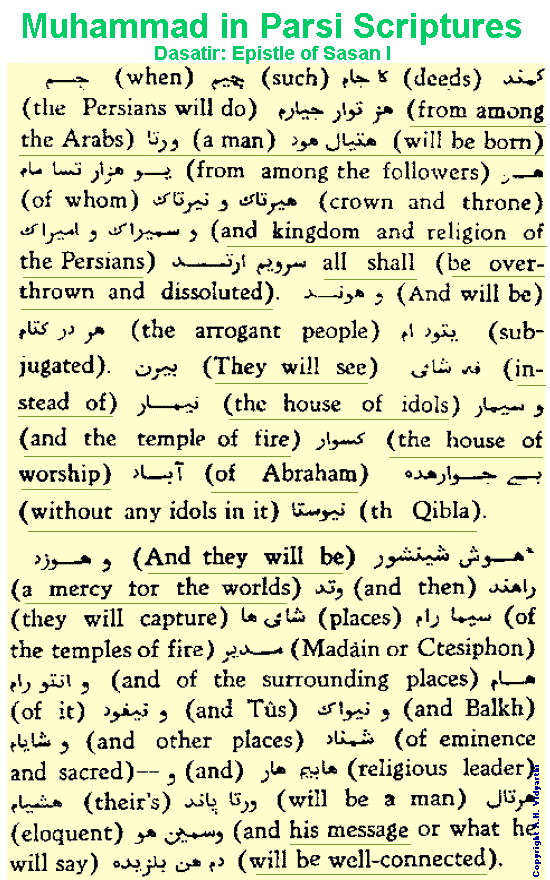
Kalki will appear in the last eon Kal Yug and will be the guide for the entire world.
He will be born on the 12th day of the month. (Prophet as born on 12th Of Rabiyyul Awwal).
His parents will be: Vishnu Bhagat and Soomati meaning servant of God and peace, respectively. (Messenger’s father’s name was Abdullah, God’s servant and mother was Amina refuge giver which includes the idea of ‘peace’.)
He will be with a beauty par-excellence. His body will be fragrant.
He will get wisdom on a mountain. (Messenger was conferred Prophethood on Mt.Hira)
He will receive a horse from God, which will be faster than lightning. Riding it, he will go around the earth and seven skies. (During Mi’raj Prophet got Buraq meaning lightning and toured the entire universe.)
Kalki will split the moon. Like Bhoj, Cheraman (Zamorin) Perumal the ruler of Indian kingdom of Kerala, witnessed splitting of the moon performed by Prophet (pbuh). After gathering the facts, he sailed to Arabia and became Muslim at Prophet’s hand. His Tomb is near the city of Salala in Oman
Prophet Muhammad (pbuh) was commanded by Allah to inform that he was not the only Messenger of God to the world (Quran Verse 46:9). Islamic scholars say that there had been some 124,000 Prophet sent to the world who preached in the language of the respective people (Quran Verse 14:4). The true religion they preached and their scriptures got corrupted with passage of time (with the exception of Quran). However, the message on the last and greatest Prophet Muhammad (pbuh) is retained till date in the scriptures of all major world religions. Some interesting information from these Books was presented here so that adherents to these religions (as also Muslims) come to know that Messenger Muhammad (pbuh) is not alien to them.
- …learned scholars – such as Abdullah bin Salam, Salman Al Farisi and other Jews who met the Prophet (pbuh) and believed. Narrated Anas: “When the news of the arrival of the Prophet (pbuh) at Al-Madina reached Abdullah bin Salam, he went to him (i.e. Prophet, pbuh) to ask him about certain things. He said, ‘I am going to ask you about three things which only a Prophet can answer: What is the first sign of the Hour? What is the first food which the people of Paradise will eat? Why does a child attract the similarity to his father or to his mother?’ The Prophet (pbuh) replied, ‘Jibril (Gabriel) has just now informed me of that’ Ibn Salam said, ‘He is the enemy of the Jews from amongst the angels’ The Prophet said, ‘As for the first sign of the Hour, it will be a fire that will collect (or gather) the people from the east to the west. As for the first meal which the people of Paradise will eat, it will be the caudate (extra) lobe of the fish-liver. As for the child, if the man’s discharge precedes the woman’s discharge, the child attracts the similarity to the man, and if the woman’s discharge precedes the man’s discharge, then the child attracts the similarity to the woman’. On this, Abdullah bin Salam said: ‘I testify that La ilaha illallah (none has the right to be worshipped but Allah) and that you are the Messenger of Allah’, and added, ‘O Allah’s Messenger! Jews make such lies as make one astonished, so please ask them about me before they know about my conversion to Islam’. The Jews came and the Prophet (pbuh) said, ‘What kind of man is Abdullah bin Salam among you?’ They replied, ‘The best of us and the son of best of us and the most superior among us, and the son of most superior among us’. The Prophet (pbuh) said. ‘What would you think if Abdullah bin Salam should embrace Islam?’ They replied, ‘May Allah protect him from that’. The Prophet repeated his question and they gave the same answer, then Abdullah came out to them and said ‘I testify that la ilaha illallah, and that Muhammad is the Messenger of Allah!’ On this, the Jews said, ‘He is the most wicked among us and the son of the most wicked among us’. So, they degraded him. On this, he said ‘It is this that I was afraid of, O Allah’s Messenger’”
فَلَمَّا جَآءَتۡهُمۡ ءَايَٰتُنَا مُبۡصِرَةٗ قَالُواْ هَٰذَا سِحۡرٞ مُّبِينٞ ١٣ وَجَحَدُواْ بِهَا وَٱسۡتَيۡقَنَتۡهَآ أَنفُسُهُمۡ ظُلۡمٗا وَعُلُوّٗاۚ فَٱنظُرۡ كَيۡفَ كَانَ عَٰقِبَةُ ٱلۡمُفۡسِدِينَ ١٤ [النمل:13-14]
But when Our Ayat came to them (Firaun and his people), clear to see, they said: ‘This is a manifest magic’. And they denied them (those Ayat) wrongfully (unjustly) and arrogantly, although their own selves were convinced thereof. So, see what was the end of the Mufsidun (disobedient, evil-doers, liars).
Surah 27 An-Naml Verses 13-14
- There are different sorts of infidelity and denial:
1- Disbelief may be as a result of following the fathers and customs and carnal desires. Most of disbelievers are of this kind.
2- Disbelief can be because of mere ignorance and conjectures.
3- Disbelief may be hidden by hypocrisy for the one who is apparently Muslim but inwardly he is a disbeliever.
4- Disbelief may emerge out of apostasy. When a person turns back from Islam, or denies some principles of the religion, such as Hajj, prayer, Zakat, and other main ordinances of the religion, or produces an innovation in the religion, he is a disbeliever.
5- Disbelief of the denial kind can come into being for the person who in his heart is assured in the legitimacy of the truth, but denies it arrogantly and because of enmity. The verse under discussion states this kind of disbelief.
So, it indicates that those accusations that they brought against Moses (pbuh) were not for the sake that they were really in doubt, but they denied the miracles unjustly and because of self-superiority. It is understood from this sentence that Faith has a reality besides knowledge and certainty, and blasphemy may exist because of denial and negation while there is knowledge and awareness. In other words, the reality of the correct Faith is an ‘outward and inward submission’ before the truth. Thus, if a person is certain of something but he does not surrender to it inwardly or outwardly, he has not faith, but he is a disbeliever of the denial kind.
It is interesting that the Quran considers the motivation of the denial of the people of Pharaoh in two things: injustice and arrogance. Their ‘injustice’ may refer to usurpation of others’ rights, and their ‘arrogance’ refers to their self-superiority over the Children of Israel. It means that they saw if they surrendered to the signs and miracles of Moses, they both would find their unlawful interests in danger and that they would stand in the same row with their slaves, the Children of Israel, and none of them were tolerable for them. Or the purpose of the Quranic word ‘unjustly’ is the injustice they did to themselves or to the divine verses, and, the purpose of the word ‘arrogantly’ is oppression over others.
وَقُلِ ٱلۡحَمۡدُ لِلَّهِ سَيُرِيكُمۡ ءَايَٰتِهِۦ فَتَعۡرِفُونَهَاۚ وَمَا رَبُّكَ بِغَٰفِلٍ عَمَّا تَعۡمَلُونَ ٩٣ [النمل:93-93]
And say (O Muhammad, pbuh, to these polytheists): ‘All praise and thanks are Allah’s. He will show you His Ayat and you shall recognize them. And your Lord is not unaware of what you do’
Surah 27 An-Naml Verse 93
- …show you His Ayat – It indicates that by the passing of time and the development of science, knowledge, and man’s wisdom, everyday some new secrets of the revelations in connection with the world of existence will be unveiled and, day after another, humankind can be acquainted more and more with the greatness of the Power of Allah and the depth of His Knowledge.
قَالَ سَنَشُدُّ عَضُدَكَ بِأَخِيكَ وَنَجۡعَلُ لَكُمَا سُلۡطَٰنٗا فَلَا يَصِلُونَ إِلَيۡكُمَا بَِٔايَٰتِنَآۚ أَنتُمَا وَمَنِ ٱتَّبَعَكُمَا ٱلۡغَٰلِبُونَ ٣٥ فَلَمَّا جَآءَهُم مُّوسَىٰ بَِٔايَٰتِنَا بَيِّنَٰتٖ قَالُواْ مَا هَٰذَآ إِلَّا سِحۡرٞ مُّفۡتَرٗى وَمَا سَمِعۡنَا بِهَٰذَا فِيٓ ءَابَآئِنَا ٱلۡأَوَّلِينَ ٣٦ [القصص:35-36]
Allah said ‘We will strengthen your arm through your brother and give you both power, so they shall not be able to harm you, with Our Ayat; you two as well as those who follow you, will be the victors’. Then when Musa (Moses) came to them with Our Clear Ayat, they said: ‘This is nothing but invented magic’. Never did we hear of this among our fathers of old’
Surah 28 Al-Qasas Verses 35-36
- Accusation and slander is one of the greatest weapons of the tyrants against the reformers. In accepting beliefs, the criterion is logic and reasoning, not the habit of the fathers. The teachings of the divine prophets are not to follow the old customs.
Interestingly, before Moses the invitation of Noah, Abraham, and Yusuf had been heard in that land. It is either because of the long length of time, or for the sake that they wanted to say that their ancestors did not submit to such invitations, too.
وَلَوۡلَآ أَن تُصِيبَهُم مُّصِيبَةُۢ بِمَا قَدَّمَتۡ أَيۡدِيهِمۡ فَيَقُولُواْ رَبَّنَا لَوۡلَآ أَرۡسَلۡتَ إِلَيۡنَا رَسُولٗا فَنَتَّبِعَ ءَايَٰتِكَ وَنَكُونَ مِنَ ٱلۡمُؤۡمِنِينَ ٤٧ [القصص:47-47]
And if (We had) not (sent you, O Muhammad, pbuh, to Makkah) – in case a calamity should seize them for (the deeds) that their hands have sent forth, they would have said: ‘Our Lord! Why did You not send us a Messenger? We would then have followed Your Ayat and would have been among the believers’.
Surah 28 Al-Qasas Verse 47
- This very thing has been presented at several places in the Quran as the reason for sending the messengers, but it will not be correct to conclude from this that a messenger should be sent on every occasion at every place for this purpose. As long as the message of a prophet remains intact in the world and the means of conveying it to others exist, there is no need for a new prophet, unless need arises to supplement the previous message, or to supplant it by a new message. Nevertheless, when the teachings of the prophets are forgotten, or become mixed up with errors and deviations and can no longer be relied upon as means of guidance, then the people do get a chance to make the excuse that there existed no arrangement whatsoever to make them aware of the distinction between the truth and the untruth and guide them to the right way: so they could not be guided aright. To meet such an excuse, Allah sends the prophets in such conditions so that anyone who follows a wrong way after that may himself be held responsible for his going astray.
Over and above, the verse refers to this point that: the path of Truth is clear, and any intellect judges the falseness of paganism and idolatry. The ugliness of a great deal of their vain deeds, like tyrannies and cruelties, belongs to the judgment of intellect, and even without sending prophets in this regard they can be punished. But, even in this field, upon which the judgment of intellect is clear, Allah sent prophets with heavenly Books and miracles in order to complete the argument and negate any kind of pretexts, so that no one can say their misfortune was because of lacking any leader and if they had divine leader(s) they would not be misguided.
However, this verse is among the verses that have indication to the necessity of Grace through sending prophets. It shows that Allah’s way of treatment is based on this fact that he should not punish any nation for their sins before sending a prophet for them:
(We sent) Messengers as bearers of good news as well as of warning in order that mankind should have no pleas against Allah after the (coming of) Messengers. (Surah 4 An-Nisa Verse 165)
وَقَٰرُونَ وَفِرۡعَوۡنَ وَهَٰمَٰنَۖ وَلَقَدۡ جَآءَهُم مُّوسَىٰ بِٱلۡبَيِّنَٰتِ فَٱسۡتَكۡبَرُواْ فِي ٱلۡأَرۡضِ وَمَا كَانُواْ سَٰبِقِينَ ٣٩ [العنكبوت:39-39]
And (We destroyed also) Qarun (Korah), Firaun (Pharaoh), and Haman. And Indeed Musa (Moses) came to them with clear Ayat, but they were arrogant in the land, yet they could not outstrip Us (escape Our punishment).
Surah 29 Al-Ankabut Verse 39
- In this holy verse, the Quran mentions the names of three persons each of whom was a clear sample of a satanic power. Korah was the epiphany of wealth together with pride, egoism, and negligence. Pharaoh was the epiphany of arrogant power furnished with mischievousness; and Haman was an example of being the assistant of the oppressive tyrants. Korah relied on his own wealth, ornament, treasures, and knowledge, while Pharaoh and Haman relied on having army, martial forces, and the great power of propagation among unaware people. Yet, with those abilities they had they could not precede Allah and escape from the grips of His power. Allah issued the command of destruction of Korah for the land, which was the place of his rest and comfort, and He commanded water, the cause of their life, to destroy Pharaoh and Haman. For destroying them, Allah did not mobilize the hosts of heavens and the earth, but what was the cause of their life executed the command of their death!
وَقَالُواْ لَوۡلَآ أُنزِلَ عَلَيۡهِ ءَايَٰتٞ مِّن رَّبِّهِۦۚ قُلۡ إِنَّمَا ٱلۡأٓيَٰتُ عِندَ ٱللَّهِ وَإِنَّمَآ أَنَا۠ نَذِيرٞ مُّبِينٌ ٥٠ أَوَ لَمۡ يَكۡفِهِمۡ أَنَّآ أَنزَلۡنَا عَلَيۡكَ ٱلۡكِتَٰبَ ٱلۡكِتَٰبَ يُتۡلَىٰ عَلَيۡهِمۡۚ إِنَّ فِي ذَٰلِكَ لَرَحۡمَةٗ وَذِكۡرَىٰ لِقَوۡمٖ يُؤۡمِنُونَ ٥١ [العنكبوت:50-51]
And they say: ‘Why are not signs sent down to him from his Lord?’ Say: ‘The signs are only with Allah, and I am only a plain warner’. Is it not sufficient for them that We have sent down to you the Book (the Quran) which is recited to them? Verily, herein is mercy and a reminder (or an admonition) for a people who believe.
Surah 29 Al-Ankabut Verses 50-51
- Is it not sufficient for them – means “Is it not sufficient as a sign for them that We have sent down to you this great Book which tells them about what happened before their time, what will happen after they are gone, and passes judgment between them. Even though you are an unlettered man who can neither read nor write, and you have not mixed with any of the people of the Book. Yet you brought the news of what was said in the first scriptures showing what is right in the matters that they dispute over, and bringing clear and obvious truth”
- Narrated Abu Hurairah that the Prophet (pbuh) said: ‘Not to wish to be the like of except two men: A man whom Allah has taught the Quran and he recites it during some hours of the night and during some hours of the day, and his neighbor listens to him and says, “I wish I had been given what has been given to so-and-so, so that I might do what he does”; and a man whom Allah has given wealth and he spends it in a just and right manner (as ordained by Allah), whereupon another man says, “I wish I had been given of what so-and-so has been given, for then I would do what he does”’
أَوَ لَمۡ يَسِيرُواْ فِي ٱلۡأَرۡضِ ٱلۡأَرۡضِ فَيَنظُرُواْ كَيۡفَ كَانَ عَٰقِبَةُ ٱلَّذِينَ مِن قَبۡلِهِمۡۚ كَانُوٓاْ أَشَدَّ مِنۡهُمۡ قُوَّةٗ وَأَثَارُواْ ٱلۡأَرۡضَ وَعَمَرُوهَآ أَكۡثَرَ مِمَّا عَمَرُوهَا وَجَآءَتۡهُمۡ رُسُلُهُم بِٱلۡبَيِّنَٰتِۖ فَمَا كَانَ ٱللَّهُ لِيَظۡلِمَهُمۡ وَلَٰكِن كَانُوٓاْ أَنفُسَهُمۡ يَظۡلِمُونَ ٩ ثُمَّ كَانَ عَٰقِبَةَ ٱلَّذِينَ أَسَٰٓـُٔواْ ٱلسُّوٓأَىٰٓ أَن كَذَّبُواْ بَِٔايَٰتِ ٱللَّهِ وَكَانُواْ بِهَا يَسۡتَهۡزِءُونَ ١٠ [الروم:9-10]
Do they (disbelieving mankind) not travel in the land, and see what was the end of those before them? They were superior to them in strength, and they tilled the earth and populated it in greater numbers than these (pagans) have done, and there came to them their Messengers with clear proofs. Surely, Allah wronged them not, but they used to wrong themselves. Then evil was the end of those who did evil, because they denied the Ayat of Allah and made a mockery of them.
Surah 30 Ar-Rum Verses 9-10
- …end of those before them - This is a historical argument for the Hereafter. It means this: The Hereafter has not been denied only by a couple of the people in the world, but a large number of them have been involved in this disbelief in human history. Even there have been entire nations which either denied it altogether or lived heedless of it, or invented such false beliefs about life after death as rendered the concept of the Hereafter meaningless. Then the continuous experience of history reveals that in whatever form the Hereafter has been denied, its inevitable result has been that the people became corrupted morally, they lived irresponsible lives, they transgressed all limits of tyranny and wickedness, which became the cause of the destruction of one nation after the other. Does not this experience of thousands of years of history, which has been traced by human generations successively, prove that the Hereafter is a reality whose denial is fatal to man? Man has come to believe in gravitation only because he has always experienced and seen material things falling to the ground. He has recognized poison to be poison only because whoever took poison died. Similarly, when the denial of the Hereafter has always led to the corruption of morals for man, is not this experience enough to teach the lesson that the Hereafter is a reality, and to live one’s life heedless of it is dangerous?
- …tilled the earth - The words athar-ul-ard in the original may either mean to plough the land for cultivation, or to dig the earth for taking out canals, underground water channels, minerals, etc. This contains an answer to the argument of those who regard mere material progress as the sign of a nation’s being righteous. They argue like this: How is it possible that Allah will make fuel of Hell those people who have exploited the resources of the earth on such a large scale, who have constructed wonderful works on the earth and given birth to grand civilizations? The Quran refutes this argument. Thus, such works of construction have also been built before by many nations on a large scale. Then, have you not seen that those nations have perished along with their civilization and their grand and magnificent works. There is no reason why the Law of Allah that has so treated in the world the mere material progress of a people lacking the right belief and conduct, will not treat them likewise in the next world and make them fuel of Hell.
- …clear proofs - That is, they came with such signs as were sufficient for anyone to be convinced of their being the true Prophets. The mention of the coming of the Prophets in this context implies this: On the one hand, there are evidences in man’s own self, and in the universe around him, and in the continuous experience of human history, and, on the other, there also came such Prophets, one after the other, who showed clear signs of their being true Prophets and warned (the people) that the Hereafter is sure to come.
- …they used to wrong themselves - That is, the destruction that overtook those nations afterwards, was not due to Allah’s being unjust to them but due to the injustice they had done to themselves. The people who neither think rightly, nor adopt the right attitude by listening to others, will be responsible for their evil end if they meet destruction Allah cannot be blamed for this, for Allah has not only made arrangements for conveying to man the knowledge of the reality through His Books and His Prophets, but also blessed man with the intellectual resources and powers by exploiting which he can always judge the authenticity of the knowledge brought by the Prophets and the Divine Books. Had Allah deprived man of this guidance and these resources and he had to meet with the consequences of following a wrong way then doubtlessly could Allah have been blamed for injustice.
ضَرَبَ لَكُم مَّثَلٗا مِّنۡ أَنفُسِكُمۡۖ هَل لَّكُم مِّن مَّا مَلَكَتۡ أَيۡمَٰنُكُم مِّن شُرَكَآءَ فِي مَا رَزَقۡنَٰكُمۡ فَأَنتُمۡ فِيهِ سَوَآءٞ تَخَافُونَهُمۡ كَخِيفَتِكُمۡ أَنفُسَكُمۡۚ كَذَٰلِكَ نُفَصِّلُ ٱلۡأٓيَٰتِ لِقَوۡمٖ يَعۡقِلُونَ ٢٨ [الروم:28-28]
He sets forth for you a parable from your own selves: Do you have partners among those whom your right hand possess (i.e. your slaves) to share as equals in the wealth We have bestowed on you whom you fear as you fear each other? Thus do We explain the signs in detail to a people who have sense.
Surah 30 Ar-Rum Verse 28
- The polytheists recognized that Allah is the Creator and Lord of the heavens and the earth and everything therein. In spite of this, they ascribed divinity to some of Allah’s creatures, declaring them to be associates in His Divinity. They addressed to them, and took them as their objects of worship. The Arabian polytheists used to utter the following words while circumambulating the Kabah: “Here we are, here we are. You have none as partner except the partner who is yours, he whom You own along with all his possessions”. In the present verse Allah refutes this brand of polytheism precisely. The purpose of this parable is to highlight the self contradiction to which the polytheists had fallen prey. On the one hand, they believed that those human beings who had accidently become their slaves could not be regarded as co-sharers of their properties. On the other hand, they believed Allah had made some of His own creatures partners in His Godhead. They should better see reason before its too late.
- ...whom you fear as you fear each other – meaning: You fear that they (the slaves) will have a share in your wealth with you.
وَلَقَدۡ أَرۡسَلۡنَا مِن قَبۡلِكَ رُسُلًا إِلَىٰ قَوۡمِهِمۡ فَجَآءُوهُم بِٱلۡبَيِّنَٰتِ فَٱنتَقَمۡنَا مِنَ ٱلَّذِينَ أَجۡرَمُواْۖ وَكَانَ حَقًّا عَلَيۡنَا نَصۡرُ ٱلۡمُؤۡمِنِينَ ٤٧ [الروم:47-47]
And indeed, We did send Messengers before you (O Muhammad, pbuh) to their own peoples. They came to them with clear proofs, then, We took vengeance on those who committed crimes (disbelief, sins); and (as for) the believers, it was incumbent upon Us to help (them).
Surah 30 Ar-Rum Verse 47
فَإِنَّكَ لَا تُسۡمِعُ ٱلۡمَوۡتَىٰ وَلَا تُسۡمِعُ ٱلصُّمَّ ٱلدُّعَآءَ إِذَا وَلَّوۡاْ مُدۡبِرِينَ ٥٢ وَمَآ أَنتَ بِهَٰدِ ٱلۡعُمۡيِ عَن ضَلَٰلَتِهِمۡۖ إِن تُسۡمِعُ إِلَّا مَن يُؤۡمِنُ بَِٔايَٰتِنَا فَهُم مُّسۡلِمُونَ ٥٣ [الروم:52-53]
So verily, you (O Muhammad, pbuh) cannot make the dead to hear the call, when they show their backs and run away. And you cannot guide the blind from their straying; you can make to hear only those who believe in Our Ayat and have submitted to Allah in Islam (as Muslims).
Surah 30 Ar-Rum Verses 52-53
- There are two ways to interpret this Ayah:
- The assessment of the Quran is not a material and physical assessment, but it is, in fact a spiritual and humane assessment. Thus considering, people are divided into four groups:
- The dead: those who do not apprehend any fact, though they are alive
- The deaf: those who cannot hear the truth, though they have ears
- The blind: those who cannot see the truth, though they have eyes
- The true believers: those who have aware hearts, hearing ears and seeing eyes
The dead signifies those whose conscience and moral sense have become totally extinct. Their all-out immersion in carnal desires as well as their adamancy and obstinacy have altogether deprived them of the capacity to comprehend and accept the truth. The deaf, no sooner do they hear the truth than they clog their ears and flee. The blind are incapable to see the Right Way or to pursue them without the risk of faltering.
- Allah, if He wills, can make the dead hear the voices of the living. In this verse, Allah says that just as you cannot make the dead to hear your voice without My Will, so also the deaf cannot hear your call nor can the blind follow your guidance without My Will. And Allah’s Will, in case of deaf and blind people, is as difficult to receive as is for the dead. Allah’s Will acts only in case of those who believe in His Ayat and submit with humility. Abdullah bin Umar reported that the Prophet (pbuh) had addressed the slain disbelievers who had been thrown into a dry well three days after the Battle of Badr, rebuking and reprimanding them, until Umar said. “O Messenger of Allah, are you addressing people who are dead bodies?” He (the Prophet, pbuh) said: ‘By the One in whose Hand is my soul, you do not hear what I say any better than they do, but they cannot respond’. Aishah interpreted this event to mean that the Prophet, pbuh, was making the point that now they would know that what he had been telling them was true. Qatadah said: “Allah brought them back to life for him so that they could hear what he said by way of rebuke and vengeance”
وَلَقَدۡ ضَرَبۡنَا لِلنَّاسِ فِي هَٰذَا ٱلۡقُرۡءَانِ مِن كُلِّ مَثَلٖۚ وَلَئِن جِئۡتَهُم بَِٔايَةٖ لَّيَقُولَنَّ ٱلَّذِينَ كَفَرُوٓاْ إِنۡ أَنتُمۡ إِلَّا مُبۡطِلُونَ ٥٨ كَذَٰلِكَ يَطۡبَعُ ٱللَّهُ عَلَىٰ قُلُوبِ ٱلَّذِينَ لَا يَعۡلَمُونَ ٥٩ [الروم:58-59]
And indeed, We set forth for mankind in this Quran every kind of parable. But if you (O Muhammad, pbuh) bring to them any sign or proof (as evidence for the truth of your Prophethood), the disbelievers are sure to say (to the believers): ‘You follow nothing but falsehood and magic’. Thus does Allah seal up the hearts of those who know not.
Surah 30 Ar-Rum Verses 58-59
- There are some seventeen places in the Quran, in which the Prophet (pbuh) is challenged to work a sign (tangible miracle). However, Allah clarifies here that miracles had proved inadequate to convince. Noah was sent with signs and with what effect? Where was the lost tribe of Thamud? They had refused to receive the preaching of the Prophet Salih, unless he showed them a sign and caused the rock to bring forth a living camel. He did what they asked. In scorn they cut the camel’s feet and then, daring the Prophet to fulfill his threats of judgment, were found dead in their beds next morning, stricken by the angel of the Lord. Even on the incident of splitting of the moon, the polytheist rejected to be Muslims (despite seeing the signs) by saying: “This is a prevalent magic! Abu Talib’s orphan affected the sky with his spell!”
أَوَ لَمۡ يَهۡدِ لَهُمۡ كَمۡ أَهۡلَكۡنَا مِن قَبۡلِهِم مِّنَ ٱلۡقُرُونِ يَمۡشُونَ يَمۡشُونَ فِي مَسَٰكِنِهِمۡۚ إِنَّ فِي ذَٰلِكَ لَأٓيَٰتٍۚ أَفَلَا يَسۡمَعُونَ ٢٦ [السجدة:26-26]
Is it not guidance for them, how many generations We have destroyed before them in whose dwellings they do walk about? Verily, therein indeed are signs. Would they not then listen?
Surah 32 As-Sajdah Verse 26
- Allah says: Will those people who deny the Messengers not learn from the nations who came before them, whom Allah destroyed for their rejection of His Messengers and their opposition to what the Messengers brought them of the Straight Path? No trace is left of them whatsoever. The disbelievers walk about in the places where those disbelievers used to live, but they do not see any of those who used to live there, for they have gone.
- ‘…signs’ – meaning, in the fact that these people are gone and have been destroyed, and in what happened to them because they disbelieved the Messengers, and how those who believed in them were saved, there are many signs, proofs and important lessons.
إِنَّآ أَرۡسَلۡنَٰكَ بِٱلۡحَقِّ بَشِيرٗا وَنَذِيرٗاۚ وَإِن مِّنۡ أُمَّةٍ إِلَّا خَلَا فِيهَا نَذِيرٞ ٢٤ وَإِن يُكَذِّبُوكَ فَقَدۡ كَذَّبَ ٱلَّذِينَ مِن قَبۡلِهِمۡ جَآءَتۡهُمۡ رُسُلُهُم بِٱلۡبَيِّنَٰتِ وَبِٱلزُّبُرِ وَبِٱلۡكِتَٰبِ ٱلۡمُنِيرِ ٢٥ ثُمَّ أَخَذۡتُ ٱلَّذِينَ كَفَرُواْۖ فَكَيۡفَ كَانَ نَكِيرِ ٢٦ [فاطر:24-26]
Verily, We have sent you (O Muhammad, pbuh) with the truth, a bearer of glad tidings and a warner. And there never was a nation but a warner had passed among them. And if they deny you, those before them also denied. Their Messengers came to them with clear signs, and with the Scriptures, and the Book giving light. Then I took hold of those who disbelieved, and how terrible was My denial (punishment)!
Surah 35 Fatir Verses 24-26
- …but a warner had passed among them - That there has been no community in the world for whose guidance Allah did not appoint the Prophets. This has been stated at several places in the Quran. In Surah Ar- Rad Verse 7, it was said: Every people has its guide. In Surah Al-Hijr Verse 10: O Prophet, We have already sent Messengers before you among many of the ancient peoples. In Surah An-Nahl Verse 36: We sent to every community a Messenger and in Surah Ash-Shuara Verse 208: We have never destroyed a habitation unless it had its warners to administer admonition. But, in this connection, one should note two things so that there remains no misunderstanding. First, one and the same Prophet is enough for the lands to which his message may reach. It is not necessary that Prophets be sent to every separate habitation and to every separate community. Second, no new Prophet needs to be sent as long as the message and teaching and guidance given by a previous Prophet remain safe and intact. It is not necessary that a separate Prophet be sent for every race and every generation.
- Scriptures, here, probably means treatise which consisted of good counsels and moral precepts and the Book comprised a complete code of the law.
وَإِذَا قِيلَ لَهُمُ ٱتَّقُواْ مَا بَيۡنَ أَيۡدِيكُمۡ وَمَا خَلۡفَكُمۡ لَعَلَّكُمۡ تُرۡحَمُونَ ٤٥ وَمَا تَأۡتِيهِم مِّنۡ ءَايَةٖ مِّنۡ ءَايَٰتِ رَبِّهِمۡ إِلَّا كَانُواْ عَنۡهَا مُعۡرِضِينَ ٤٦ [يس:45-46]
And when it is said to them: ‘Fear of that which is before you and that which is behind you, in order that you may receive mercy’. And never came an Ayah from among the Ayat of their Lord to them, but they did turn away from it.
Surah 36 Ya-Sin Verses 45-46
- …that which is before you – refers to worldly torments.
- …that which is behind you – refers to torments in the Hereafter.
- …they turn away from it – This emphasizes and distinguishes the obstinacy of the blind hearted in neglecting the Ayat of Allah. Neither the statements of introversive verses have any effect on them nor do threat nor do glad tidings guide them to the mercy of Allah. They accept neither the logic of intellect nor the command of sympathy and nature. They are like some blind people who do not see the nearest things around them and do not differ between the light of the sun and the darkness of the night.
وَإِذَا رَأَوۡاْ ءَايَةٗ يَسۡتَسۡخِرُونَ ١٤ وَقَالُوٓاْ إِنۡ هَٰذَآ إِلَّا سِحۡرٞ مُّبِينٌ ١٥ أَءِذَا مِتۡنَا وَكُنَّا تُرَابٗا وَعِظَٰمًا أَءِنَّا لَمَبۡعُوثُونَ ١٦ أَوَ ءَابَآؤُنَا ٱلۡأَوَّلُونَ قُلۡ ١٧ نَعَمۡ وَأَنتُمۡ دَٰخِرُونَ فَإِنَّمَا ١٨ فَإِنَّمَا هِيَ زَجۡرَةٞ وَٰحِدَةٞ فَإِذَا هُمۡ يَنظُرُونَ ١٩ [الصّافّات:14-19]
And when they see an Ayah from Allah, they mock at it. And they say: ‘This is nothing but evident magic! When we are dead and have become dust and bones, shall we (then) verily be resurrected? And also our fathers of old?’ Say (O Muhammad, pbuh): ‘Yes, and you shall then be humiliated’. It will be a single Zajrah (shout – blowing of the Trumpet) and behold, they will be staring.
Surah 37 As-Saffat Verses 14-19
بَلَىٰ قَدۡ جَآءَتۡكَ ءَايَٰتِي فَكَذَّبۡتَ بِهَا وَٱسۡتَكۡبَرۡتَ وَكُنتَ مِنَ ٱلۡكَٰفِرِينَ ٥٩ وَيَوۡمَ ٱلۡقِيَٰمَةِ تَرَى ٱلَّذِينَ كَذَبُواْ عَلَى ٱللَّهِ وُجُوهُهُم مُّسۡوَدَّةٌۚ أَلَيۡسَ فِي جَهَنَّمَ مَثۡوٗى لِّلۡمُتَكَبِّرِينَ ٦٠ [الزمر:59-60]
Yes! Verily, there came to you My Ayat and you denied them, and were proud and were among the disbelievers. And on the Day of Resurrection, you will see those who lied against Allah – their faces will be black. Is there not in Hell an abode for the arrogant?
Surah 39 Az-Zumar Verses 59-60
- The sinful express some words on the Day of Resurrection:
1. Confessing to neglect
2. Confessing to derision
3. Wishing for guidance
4. Wishing for returning to the world.
No answer is suggested for the first word, since it is an inevitable reality – they have to regret and grieve for their past vicious deeds.
A reply is provided for the second word as per which divine verses came unto him; however, he denied them and was vain and one of the disbelievers. He is saying that had divine guidance came unto him, he would have been one of the righteous. What are divine guidance but so many Divine Books, Allah’s Messengers, Divine Verses and Signs of Truth in horizons and souls? He saw and heard them all but what was his reaction toward them except denial, vanity, and disbelief? Would it be possible that Allah chastises anyone without warning them? Was he different from the guided in terms of Divine Guidance? Therefore, he is to blame for his evil deeds. Vanity and denial of Divine Verses and Signs are the main reasons that lead to disbelief and faithlessness.
Allah accepts his confessions but concerning the third word, the Verse in question says that Allah provided you with guidance but he denied it.
An answer provided for the fourth word is to be found elsewhere:
And even if they were returned (to the world), they would certainly revert to that which they were forbidden. And indeed, they are liars. (Verse 6:28)
It is worthy of note that Allah had already warned them and such further warnings would be futile. Experiencing torment in the Hereafter is their sudden awakening which will be rendered futile upon their return to the world.
مَا يُجَٰدِلُ فِيٓ ءَايَٰتِ ٱللَّهِ إِلَّا ٱلَّذِينَ كَفَرُواْ فَلَا يَغۡرُرۡكَ تَقَلُّبُهُمۡ فِي ٱلۡبِلَٰدِ ٤ [غافر:4-4]
None disputes in the Ayat of Allah but those who disbelieve. So let not their ability of going about here and there through the land deceive you (for their ultimate end will be the fire of Hell)!
Surah 40 Ghafir Verse 4
- Kufr (disbelief) carries the following two meanings here:
- Ingratitude – taken in this sense, the verse means that thanklessness is manifest from the behavior of those who tend to forget Allah’s bounties that were unremittingly showered on them.
- Rejection of the truth – this is implied in the attitudinal trait of those who dispute Allah’s signs; who turn away from the truth and make up their minds not to accept it.
- It is clear from the context that the verse does not allude to unbelievers as such. For well meaning unbelievers may raise a question about Islam in order to pursue their quest for the truth. What it refers to is indulgence in unnecessary disputation, resort to hair-splitting objection against Allah’s message or distortion of its meaning so as to obstruct others and one’s own self from comprehending it.
- …ability of going about - Those who contend and wrangle about Allah’s signs, despite their wickedness, they strut with impunity, their trade and commerce thrive, their states function with pomp and splendor and they are immersed in self-indulgence without any let or hindrance. All this should, however, not delude anyone into thinking that such people will not be seized by Allah’s punishment. They have been only granted respite: the more they misuse it to act wickedly, the more harm they will cause to themselves.
۞أَوَلَمۡ يَسِيرُواْ فِي ٱلۡأَرۡضِ فَيَنظُرُواْ كَيۡفَ كَانَ عَٰقِبَةُ ٱلَّذِينَ كَانُواْ مِن قَبۡلِهِمۡۚ كَانُواْ هُمۡ أَشَدَّ مِنۡهُمۡ قُوَّةٗ وَءَاثَارٗا فِي ٱلۡأَرۡضِ فَأَخَذَهُمُ ٱللَّهُ بِذُنُوبِهِمۡ وَمَا كَانَ لَهُم مِّنَ ٱللَّهِ مِن وَاقٖ ٢١ ذَٰلِكَ بِأَنَّهُمۡ كَانَت تَّأۡتِيهِمۡ رُسُلُهُم بِٱلۡبَيِّنَٰتِ فَكَفَرُواْ فَأَخَذَهُمُ ٱللَّهُۚ إِنَّهُۥ قَوِيّٞ شَدِيدُ ٱلۡعِقَابِ ٢٢ [غافر:21-22]
Have they not travelled in the land and seen what was the end of those who were before them? They were superior to them in strength, and in the traces (which they left) in the land. But Allah seized them with punishment for their sins. And none had they to protect from Allah. That was because there came to them their Messengers with clear evidences but they disbelieved (in them). So Allah seized them (with punishment). Verily, He is All-Strong, Severe in punishment.
Surah 40 Ghafir Verses 21-22
- ‘clear evidences’ – the word bayyinat signifies the following:
- The clear, distinct signs which attest that the Messenger had been raised by Allah
- The weighty arguments which prove that the teachings of those Messengers were utterly true; and
- The valuable guidance about various aspects of life that would convince every sensible person that a liar or selfish person could not have imparted such teachings as is so utterly true and morally so unblemished.
وَلَقَدۡ أَرۡسَلۡنَا رُسُلٗا مِّن قَبۡلِكَ مِنۡهُم مَّن قَصَصۡنَا عَلَيۡكَ وَمِنۡهُم مَّن لَّمۡ نَقۡصُصۡ عَلَيۡكَۗ وَمَا كَانَ لِرَسُولٍ أَن يَأۡتِيَ بَِٔايَةٍ إِلَّا بِإِذۡنِ ٱللَّهِۚ فَإِذَا جَآءَ أَمۡرُ ٱللَّهِ قُضِيَ بِٱلۡحَقِّ وَخَسِرَ هُنَالِكَ ٱلۡمُبۡطِلُونَ ٧٨ [غافر:78-78]
And indeed, We have sent Messengers before you (O Muhammad, pbuh), of some of them We have related to you their story. And of some We have not related to you their story, and it was not given to any Messenger that he should bring a sign except by the Leave of Allah. But, when comes the Commandment (i.e. torment) of Allah, the matter will be decided with truth, and the followers of falsehood will then lose (everything).
Surah 40 Ghafir Verse 78
- …except by the leave of Allah - The disbelievers of Makkah said to the Prophet (pbuh): We would not believe you to be Allah’s Messenger unless you showed us the miracle that we ask you to show us. In the following verses an answer is being given to this very demand without mentioning it. No Prophet ever showed a miracle by his own will and desire, nor had any Prophet the power to show a miracle by himself. Whenever a miracle was shown through a Prophet, it was shown when Allah willed it to be shown through him to the disbelievers. This is the first answer to the disbelievers' demand.
- …the matter will be decided - That is, a miracle has never been shown for the mere fun of it. It is a decisive thing. If a nation does not believe even after a miracle has been shown, it is destroyed. You are demanding a miracle only for the sake of fun, but you have no idea that by making such a demand you are, in fact, inviting your own doom. This is the second answer to their demand.
وَمِنۡ ءَايَٰتِهِۦٓ أَنَّكَ تَرَى ٱلۡأَرۡضَ خَٰشِعَةٗ فَإِذَآ أَنزَلۡنَا عَلَيۡهَا ٱلۡمَآءَ ٱهۡتَزَّتۡ وَرَبَتۡۚ إِنَّ ٱلَّذِيٓ أَحۡيَاهَا لَمُحۡيِ ٱلۡمَوۡتَىٰٓۚ إِنَّهُۥ عَلَىٰ كُلِّ شَيۡءٖ قَدِيرٌ ٣٩ [فصّلت:39-39]
And among His Signs (is that), that you see the earth barren, but when We send down water (rain) to it, it is stirred to life and growth. Verily, He Who gives it life, surely is able to give life to the dead. Indeed, He is Able to do all things.
Surah 41 Fussilat Verse 39
- The unbelievers foolishly dismiss the Hereafter simply as something that can never take place. They are under the illusion that regardless of whatever they do in the world, the moment will never come when they will be made to stand before Allah to render an account of their deeds. Such a thought, however, is sheer fantasy. For, on the Day of Judgment, at a simple command from Allah, all the dead will be raised to life. This will happen in the same manner as when a shower of rain revives a seemingly sterile patch of land, causing the long dormant roots that had remained buried in the recess of earth to blossom forth.
- We see around us that there are almost limitless seeds of a variety of things that are scattered all around by the birds and winds. There are also roots of a very large number of plants and trees which lie hidden in the earth. In an arid terrain, there is no trace of any plant life. The barren tracts of land seem altogether dead as if they were a large graveyard. But as soon as few drops of rain fall on the piece of land, verdant life begins to pulsate all over. Every dead root is resurrected; every lifeless seed becomes a living plant. This process of the resurrection of the dead takes place every year before our own eyes.
هَٰذَا هُدٗىۖ وَٱلَّذِينَ كَفَرُواْ بَِٔايَٰتِ رَبِّهِمۡ لَهُمۡ عَذَابٞ مِّن رِّجۡزٍ أَلِيمٌ ١١ [الجاثية:11-11]
This (Quran) is a guidance. And those who disbelieve in the Ayat of their Lord, for them there is a painful torment of Rijz.
Surah 45 Al-Jathiyah Verse 11
- The word Rijz denotes anxiety and may connote rijs (filth). The verse may connote that disbelievers shall be chastised by polluted and disgusting material.
مَثَلُ ٱلَّذِينَ حُمِّلُواْ ٱلتَّوۡرَىٰةَ ثُمَّ لَمۡ يَحۡمِلُوهَا كَمَثَلِ ٱلۡحِمَارِ يَحۡمِلُ أَسۡفَارَۢاۚ بِئۡسَ مَثَلُ ٱلۡقَوۡمِ ٱلَّذِينَ كَذَّبُواْ بَِٔايَٰتِ ٱللَّهِۚ وَٱللَّهُ لَا يَهۡدِي ٱلۡقَوۡمَ ٱلظَّٰلِمِينَ ٥ [الـجـمـعـة:5-5]
The likeness of those who were entrusted with the Taurah (Torah - to obey its commandments and to practice its laws), but who subsequently failed in those, is as the likeness of a donkey which carries huge burdens of books (but understands nothing from them). How bad is the example of people who deny the Ayat of Allah. And Allah guides not the people who are Zalimun (polytheists, wrong-doers).
Surah 62 Al-Jumuah Verse 5
- …those who were entrusted – This sentence have two meanings - a general meaning and a special meaning. The general meaning is that the people, who were entrusted with the knowledge and practice of the Torah, and with the responsibility of guiding the world according to it, neither understood their responsibility nor discharged it as they should have. The special meaning is that being the bearers of the Torah these people should have been foremost to join hands with the Messenger (pbuh), good news about whose advent had been already given in the Torah, but, instead, they have been in the forefront to oppose him and have thus failed to fulfill the demand of the teaching of the Torah.
- …donkey – The Jews contended themselves with the recitation of the Torah without reflecting upon its contents and acting upon them, the similitude of such people is the animal proverbial for ignorance. It is the most telling similitude for those who claim to know something but fail to act upon their pretended knowledge, since they carry the burden of knowledge without being blessed by its blessings.
- Those who deal with the words of the Holy Quran without being aware of its contents and fruitful lessons are similar to those mentioned herein. It is a warning also to the Muslims to be aware such that they do not end up like the Jews. Such great divine bounty is not for merely keeping at home without reading it and reflecting upon it or pass beneath it before travelling or send it with a mirror to a new house. Thus, they degrade their scripture to such an extent. Their utmost efforts may be to recite it beautifully and commit it to heart without any reflection in their individual and social life through reflecting upon its verses and acting upon its injunctions.
B
أَنزَلَ مِنَ ٱلسَّمَآءِ مَآءٗ فَسَالَتۡ أَوۡدِيَةُۢ بِقَدَرِهَا فَٱحۡتَمَلَ ٱلسَّيۡلُ زَبَدٗا رَّابِيٗاۖ وَمِمَّا يُوقِدُونَ عَلَيۡهِ فِي ٱلنَّارِ ٱبۡتِغَآءَ حِلۡيَةٍ أَوۡ مَتَٰعٖ زَبَدٞ مِّثۡلُهُۥۚ كَذَٰلِكَ يَضۡرِبُ ٱللَّهُ ٱلۡحَقَّ وَٱلۡبَٰطِلَۚ فَأَمَّا ٱلزَّبَدُ فَيَذۡهَبُ جُفَآءٗۖ وَأَمَّا مَا يَنفَعُ ٱلنَّاسَ فَيَمۡكُثُ فِي ٱلۡأَرۡضِۚ كَذَٰلِكَ يَضۡرِبُ ٱللَّهُ ٱلۡأَمۡثَالَ ١٧ [الرّعد:17-17]
He sends down water (rain) from the sky, and the valleys flow according to their due measure, but the flood bears away the foam that mounts up to the surface – and (also) from that (ore) which they heat in the fire in order to make ornaments or utensils, rises a foam like it, thus does Allah (by parables) show forth truth and falsehood. Then, as for the foam it passes away as scum upon the banks, while that which is for the good of mankind remains in the earth. Thus, Allah sets forth parables (for the truth and falsehood – belief and disbelief).
Surah 13 Ar-Ra’d Verse 17
- Commentators of the Holy Quran have given many points when talking about this verse. Some of these points are summarized below:
1. The rain falls equally on the surfaces of the earth, but the acceptance and absorption by the ground depends on the ground quality. Some soil will absorb enough water for growth, and the water turns it into a fertile place. Other types of soil will not have the capacity to absorb much, and will remain barren. Such is the example of Divine revelation and the human heart. The wisdom and guidance from the Almighty come for everyone, but each human being accepts and derives benefit from it according to his capacity.
2. Truth and falsehood are sometimes difficult to distinguish. Often, falsehood is disguised as a form of truth, and has many advocates who will vouch for it. This point is especially true in today’s modern world, where truth and falsehood in moral and ethical issues are often indistinguishable. In the verse above, the Almighty gives us the following signs to identify truth and falsehood:
a) Truth is always useful and beneficial. Like the flowing water that is a source of life, truth gives life and spirit to everything it comes into contact with. Falsehood on the other hand, is useless and superfluous. The foam on top of the water does not quench any thirst, nor cause any greenery to grow. It has no benefit for the human being.
b) Falsehood is always on top, making a lot of noise and movement. It invites attention and seems large, but like the foam is empty inside. Truth is humble, quiet, and content to stay at the bottom. It has weight and value, and does not need to attract attention to be worthy. Imam Ali used to say: Truth is heavy and wholesome, while falsehood is light and bitter.
c) Truth is strong and always depends on itself. It is often used as a support. Falsehood depends on others to exist. It tries to disguise itself in the dress of truth, and use it to support itself.
3. Truth will always overcome falsehood, even if it takes some time. Those who have neither patience nor wisdom to know that this will eventually be the outcome are deceived by falsehood. Wise people however, are content to wait. They know that truth will ultimately emerge the winner. Almighty Allah says in Surat al-Anbiya: Nay! We cast the truth against the falsehood, so that it breaks its head, and lo! It vanishes. (Verse 21:18). The foam may be strong for a while, but will eventually disappear.
4. When the water calms down and enters a flat area, the foam subsides and soon disappears. Clear and pure water then becomes visible. When human beings become tranquil and are ready to see the truth, the falsehood on top of the truth subsides and disappears. Truth, in all its purity, is then recognized and accepted.
The above verse of the Holy Quran is a beautiful example of how human beings can learn much from nature. It is a great loss if we pass by such wonderful lessons of nature, seeing them but not really understanding them. That is why the Almighty reminds us often in the Holy Quran to ponder over creation.
COMMENTS FROM VARIOUS SCHOLARS
‘The Meccans still demanded of him a miracle, and with remarkable boldness and self confidence Mohammad appealed as a supreme confirmation of his mission to the Koran itself. Like all Arabs they were the connoisseurs of language and rhetoric. Well, then if the Koran were his own composition other men could rival it. Let them produce ten verses like it. If they could not (and it is obvious that they could not), then let them accept the Koran as an outstanding evident miracle’.
(The well-known Arabist Hamilton Gibb of the University of Oxford)
‘On the whole we find in it a collection of wisdom which can be adopted by the most intelligent of men, the greatest of philosophers and the most skilful of politicians… But there is another proof of the Divinity of the Qur'an; it is the fact that it has been preserved intact through the ages since the time of its Revelation till the present day… Read and reread by the Muslim world, this book does not rouse in the faithful any weariness, it rather, through repetition, is more loved every day. It gives rise to a profound feeling of awe and respect in the one who reads it or listens to it… Therefore, above all, what caused the great and rapid diffusion of Islam was through the fact that this Book… was the book of Allah…’
(From Laura Veccia Vaglieri's book, Apologie de I'Islamisme)
‘The Koran abounds in excellent moral suggestions and precepts; its composition is so fragmentary that we cannot turn to a single page without finding maxims of which all men must approve. This fragmentary construction yields texts, and mottoes, and rules complete in themselves, suitable for common men in any of the incidents of life’.
(From John William Draper's book, A History of the Intellectual Development of Europe)
‘It must be acknowledged, too, that the Koran deserves the highest praise for its conceptions of the Divine nature in reference to the attributes of Power, knowledge and universal Providence and Unity-that its belief and trust in the one Allah of Heaven and Earth is deep and fervent-and that… it embodies much of the noble and deep moral earnestness, and sententious oracular wisdom, and has proved that there are elements in it on which mighty nations and conquering… Empires can be built up’.
(From the preface of The Koran, translated from the Arabic by Rev. J. M. Rodwell)
‘The Qur'an has invariably kept its place as the fundamental starting point… A creed so precise, so accessible to the ordinary understanding might be expected to possess and does indeed possess a marvelous power of winning its way into the consciences of men’.
(Edward Montet, a French intellectual)
‘The strength of the Koran is that a Muslim, or anyone, can open it to any page and get a message dealing with life's meaning’.
(The well-known theologian John Esposito)
‘…the Qur'an is explicit in the support of the freedom of conscience’.
(From James Michener's article, "Islam: The Misunderstood Religion")
‘Sense of justice is one of the most wonderful ideals of Islam, because as I read in the Qur'an I find those dynamic principles of life, not mystic but practical ethics for the daily conduct of life suited to the whole world’.
(From a lecture on "The Ideals of Islam" quoted in the book Speeches and Writings of Sarojini Naidu)
‘A miracle of purity of style, of wisdom and of truth’.
(From Rev. R. Bosworth Smith's book, Mohammed and Mohammadanism)
‘I hope the time is not far off when I shall be able to unite all the wise and educated men of all the countries and establish a uniform regime based on the principles of Qur'an which alone are true and which alone can lead men to happiness’.
(French Emperor Napoleon Bonaparte)
‘Everything made so much sense. This is the beauty of the Qur'an; it asks you to reflect and reason... When I read the Qur'an further, it talked about prayer, kindness and charity. I was not a Muslim yet, but I felt the only answer for me was the Qur'an and Allah had sent it to me’.
(Yusuf Islam [Cat Stevens], former British pop star)